El presidente de la Fifa, Gianni Infantino, sigue contra las cuerdas tras la crisis que generó su idea de abrir la puerta a inversores privados en la entidad rectora del fútbol mundial. La iniciativa ha perdido fuerza hasta el punto de que varias federaciones ya comenzaron a retirarle su respaldo.
Lo que se conoció este lunes es que la Asociación de Fútbol de Gales (FAW) se convirtió en la primera federación en retirar su apoyo a Gianni Infantino, quien busca la reelección para un nuevo mandato, debido a su fallido plan para aceptar inversión privada en las competiciones organizadas por la Fifa.
Gianni Infantino sigue contra las cuerdas: presidente de la Fifa recibe duro mazazo
Infantino anunció la semana pasada que abandonaba el proyecto, que había provocado una protesta internacional. Sin embargo, la asociación galesa anunció este lunes que, pese al paso atrás dado por el dirigente italosuizo, no respaldará su candidatura, precisó la agencia AFP.
Gianni Infantino Foto:Gianni Infantino
La asociación galesa emitió un comunicado en el que citó “fallos en materia de buen gobierno, proceso y liderazgo”, y añadió que no apoyará la candidatura de Infantino para el mandato 2027-2031, informó la agencia.
Lo que dijeron en Gales
“La Asociación de Fútbol de Gales confirma mediante este comunicado el retiro de su apoyo a la candidatura del señor Gianni Infantino”, indicó la FAW.
Gianni Infantino (izq) y Aleksander Ceferin Foto:EFE
La federación añadió que también existen deficiencias “en materia de valores, gestión de las partes interesadas, comunicación y buen criterio”. La FAW señaló que todos esos desacuerdos con la gestión del dirigente la han llevado a considerar que “Infantino ha perdido la confianza necesaria para seguir al frente del fútbol mundial”.
“No poner los intereses del fútbol por encima de todo lo demás es un fracaso que no podemos aceptar”, añadió la federación galesa.
Gianni Infantino Foto:EFE
El viernes, el primer ministro británico, Andy Burnham, estimó que Infantino es “la persona equivocada” para dirigir la Fifa, tras el anuncio de su proyecto para abrir la organización a inversores privados.
“Fue una propuesta escandalosa. El mero hecho de que se haya contemplado demuestra, en mi opinión, que Gianni Infantino es la persona equivocada para dirigir la organización”, declaró el jefe de Gobierno británico durante una visita a Sheffield, en el norte del país.
Esas declaraciones de Burnham reafirmaron las que había hecho en su primera reacción al conocer el proyecto de la Fifa.
Gianni Infantino Foto:EFE
“El fútbol no pertenece a inversores”, escribió el primer ministro el martes en la red social X. “Pertenece a quienes llenan las tribunas y están al borde del terreno de juego semana tras semana, llueva o haga sol. El Mundial no es un producto. Es la competición más grande del deporte mundial y nunca le ha pertenecido a nadie para ser vendido”, reaccionó este reconocido aficionado del Everton, concluyó la agencia.
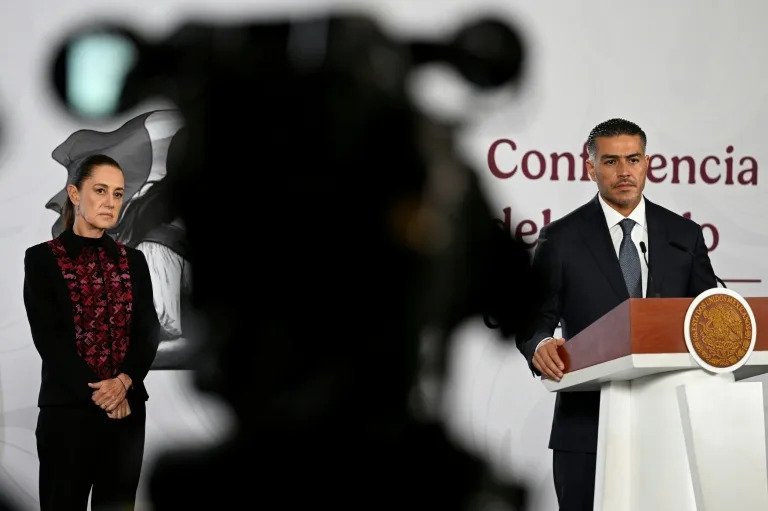
El ejército de México capturó al líder de un cártel narcotraficante por el que Estados Unidos ofrecía una recompensa de 5 millones de dólares, informó este sábado el secretario de Seguridad, Omar García Harfuch.
El individuo, identificado por la prensa local como Alfonso Fernández Magallón, es señalado como líder del cártel de Los Reyes, que opera en el estado de Michoacán (oeste), indicó el funcionario en un mensaje en redes sociales.
“El detenido cuenta con una orden de aprehensión por los delitos de privación ilegal de la libertad y motín”, indicó García Harfuch en su publicación donde destacó la recompensa que el gobierno estadounidense ofrecía por su captura.
Michoacán, del tamaño de Costa Rica, es el epicentro de una millonaria industria agroexportadora y posee además un importante puerto en su costa Pacífica, lo que atrae a la extorsión, el narcotráfico y la violencia.
Tras el arresto, miembros del cártel de Los Reyes “realizaron bloqueos e incendiaron vehículos” en dos municipios de Michoacán, agregó el secretario quien garantizó, no obstante, la seguridad en dicha entidad.
El embajador estadounidense en México, Ronald Johnson, “aplaudió” el trabajo del ejército y del gabinete de seguridad mexicanos y aseguró que su captura “envía otro mensaje claro: los delincuentes no tienen dónde esconderse”.
Añadió que el “compromiso compartido” de México y Washington “de desmantelar los cárteles y hacer que los criminales violentos rindan cuentas sigue dando resultados”.
De la Espriella afirmó que el programa Colombia Mayor enfrenta un faltante de $3,2 billones para garantizar los pagos del resto del año. FOTO: CAPTURA DE PANTALLA
El presidente electoAbelardo de la Espriella ratificó una de sus principales promesas de campaña: aumentar el subsidio del programa Colombia Mayor hasta $400.000 mensuales. Sin embargo, aclaró que la medida no entrará en vigor de inmediato, sino únicamente después de reorganizar las finanzas públicas y garantizar la continuidad del programa, que, según afirmó, recibió con un déficit de $3,2 billones.
Durante su última alocución antes de asumir la Presidencia el próximo 7 de agosto, el mandatario electo aseguró que el panorama financiero encontrado por su equipo de empalme obliga a priorizar la consecución de recursos para garantizar los pagos a cerca de tres millones de adultos mayores beneficiarios del programa durante lo que resta del año.
“Estoy recibiendo el programa Colombia Mayor absolutamente desfinanciado. El gobierno irresponsable y ladrón que gracias a Dios ya termina, se gastó la plata de nuestros viejitos en el primer semestre del año, en plena campaña electoral. Los recursos que debían alcanzar para todo el año se agotaron en julio y hoy hacen falta $3,2 billones para garantizar los pagos de agosto a diciembre de cerca de tres millones de adultos mayores”, expresó el presidente electo.
De la Espriella sostuvo que el faltante presupuestal obligará a realizar ajustes durante las primeras semanas de su administración y aseguró que su prioridad será asegurar que los beneficiarios continúen recibiendo el subsidio.
“Les digo con la mano en el corazón: les voy a cumplir. Los pagos se harán. Solamente les pido unas semanas mientras ponemos un poco la casa en orden, eliminamos el gasto innecesario y destinamos esos recursos a quienes más lo necesitan”, manifestó.
Como parte de esa estrategia, anunció que la directora designada del Departamento para la Prosperidad Social (DPS), Sandra Suárez, y el próximo ministro de Hacienda, Miguel Gómez Martínez, tendrán la instrucción de concentrar esfuerzos en encontrar los recursos que permitan cubrir el déficit del programa y garantizar los desembolsos correspondientes a los últimos cinco meses del año.
Aunque reiteró su compromiso de fortalecer el apoyo económico para los adultos mayores, el mandatario electo aclaró que el incremento del subsidio hasta $400.000 mensuales dependerá de que el nuevo gobierno logre estabilizar la situación financiera del Estado.
“Una vez superemos este desastre, este desorden financiero, voy a aumentar el subsidio de Colombia Mayor a $400.000 mensuales, porque quienes trabajaron toda una vida por este país merecen una vejez digna”, afirmó.
Actualmente, el programa entrega un subsidio mensual de $80.000 a los beneficiarios menores de 80 años y de $225.000 a quienes superan esa edad, por lo que la propuesta representaría un incremento significativo frente a los valores vigentes.
El anuncio constituye una de las primeras definiciones de política social del gobierno entrante, pero también representa un desafío fiscal. Además de cubrir el faltante de $3,2 billones que, según De la Espriella, presenta actualmente el programa, el Ejecutivo deberá encontrar nuevas fuentes de financiación para asumir el mayor costo que implicaría elevar el subsidio a $400.000 para millones de beneficiarios.
En ese contexto, el presidente electo aseguró que una de las primeras tareas de su administración será reorganizar las finanzas públicas y fortalecer la caja del Estado. Según indicó,ya impartió instrucciones al vicepresidente y al ministro de Hacienda designado para identificar mecanismos que permitan responder a los compromisos presupuestales más urgentes.
Durante su intervención también sostuvo que organismos multilaterales, el sistema financiero y el sector privado han manifestado confianza en el nuevo gobierno, un respaldo que, según dijo, contribuiría a facilitar la recuperación económica y la estabilización de las finanzas públicas.
La decisión de aplazar el aumento del subsidio hasta sanear las cuentas del Estado marca el primer gran reto fiscal del gobierno que comenzará el próximo 7 de agosto: garantizar la continuidad de uno de los principales programas sociales del país antes de ampliar el monto de las transferencias económicas a la población adulta mayor.
Para consultar contenido prémium o profundizar sobre sus temas de interés de Medellín, Antioquia, Colombia y el mundo,regístrese aquí.
The Eastern Conference may be the deeper when it comes to teams that could finish with winning records in the 2026-27 season. But the West still has the San Antonio Spurs and Oklahoma City Thunder.
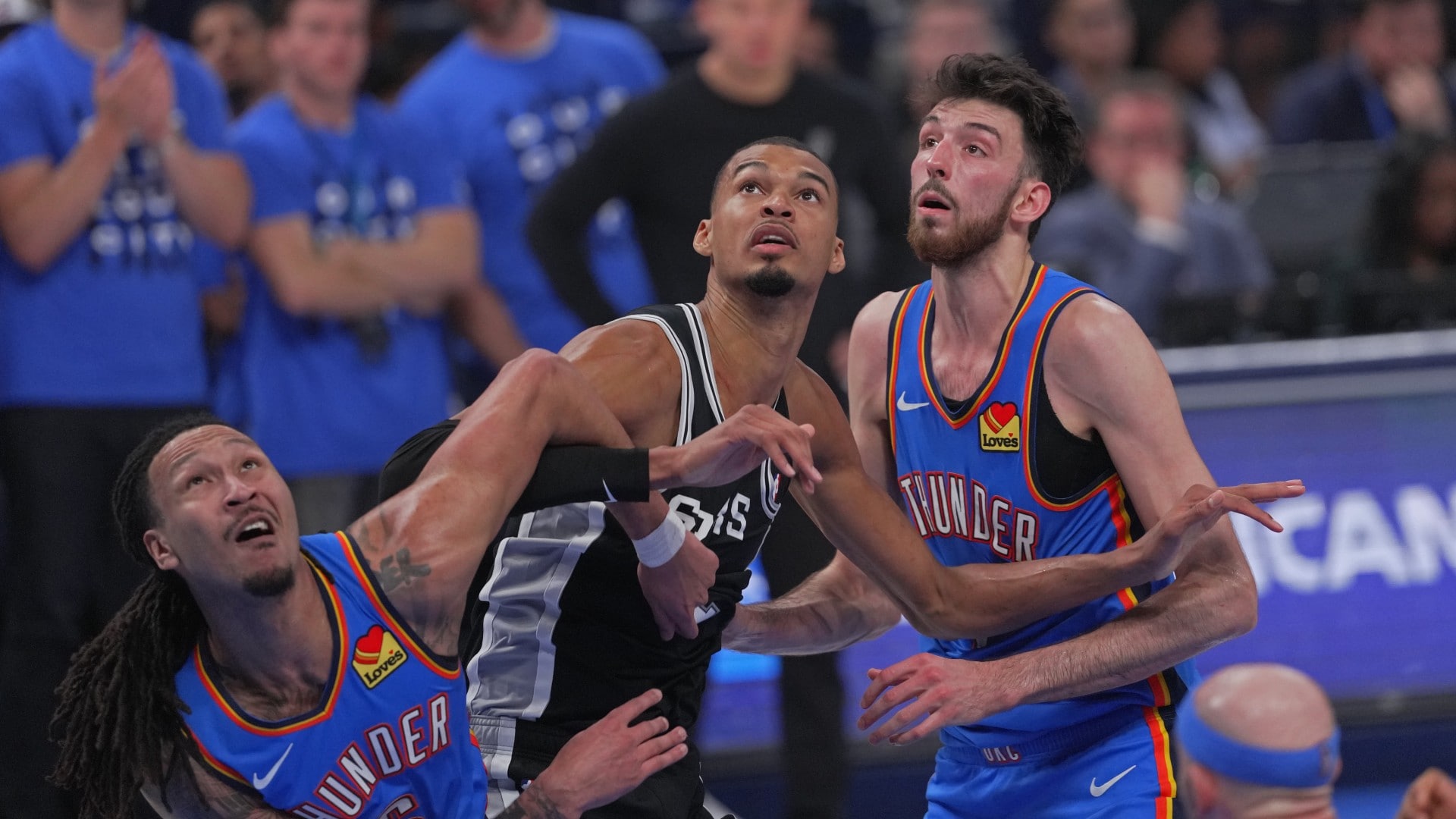
Over the last two seasons (and including playoffs), the Thunder have outscored their opponents by an amazing 11.2 points per game. Simply, they’ve had two of the best seasons in NBA history. But they met their match last season, with the Spurs winning eight of the 12 head-to-head matchups, including Game 7 of the Western Conference finals in Oklahoma City.
The Thunder have had to shed some of their depth, but they should be getting more games and minutes from Jalen Williams than they did last season, while seeing some improvement from their young core. Speaking of young cores, the Spurs’ Dylan Harper, Stephon Castle and Victor Wembanyama are just 20, 21 and 22 years old, respectively.
So it looks like we’re going to get another epic battle between Oklahoma City and San Antonio, both in the regular season and in the playoffs. But is there a third Western Conference team that can challenge the top two? Can a Play-In or Lottery team from last season climb into the top six?
Here’s a crack at how the Western Conference stacks up as we enter the month of August, with some offseason business still to be done.
Note: For these offseason rankings, we’re looking at each conference separately, with the Eastern Conference rankings having been published last week. All stats refer to the 2025-26 regular season unless otherwise noted. Last week’s rank is based on how team’s finished in the playoffs, Play-In and regular season.
Previously…
OffRtg: Points scored per 100 possessions (League Rank) DefRtg: Points allowed per 100 possessions (League Rank) NetRtg: Point differential per 100 possessions (League Rank)
The league averaged 114.8 points scored per 100 possessions and 100.2 possessions (per team) per 48 minutes last season.
NBA.com’s Power Rankings, released every Monday during the season, are just one man’s opinion. If you have an issue with the rankings, or have a question or comment for John Schuhmann, contact him via Bluesky.
Key departures: Lu Dort, Isaiah Joe, Aaron Wiggins
Three numbers to know…
The Thunder allowed 8.3 fewer points per 100 possessions than the league average (114.8), which was the second best differential for any team in the 30 seasons for which we have play-by-play data, topped by only that of the 2003-04 Spurs.
Shai Gilgeous-Alexander scored 1.18 points per possession as a pick-and-roll ball-handler, the best mark for a player with at least 200 ball-handler possessions in the 22 seasons of Synergy tracking. He was the first player in the 13 seasons of camera-tracking data to shoot 55% or better on at least 500 pull-up 2-point attempts.
Key question: How much does depth matter?
The Thunder have had the league’s top-ranked bench (by wide margins) in each of the last two seasons. But they’ve just salary-dumped guys who ranked second, fifth and sixth on the team in total minutes over those two years. Both Ajay Mitchell and Cason Wallace appear ready for bigger roles, but Gilgeous-Alexander probably won’t be the only Thunder player averaging at least 30 minutes this season, and it’ll be tougher to be extra cautious with Alex Caruso’s playing time.
It may all come down to how well the Thunder match up with the Spurs, with the 107.9 points per 100 possessions they scored in the conference finals being their worst offensive mark for any of their nine playoff series in the last three years. But they basically had Jalen Williams for just one of those seven games, and he could make up for much of the lost depth if he’s fully recovered from his multiple injuries over the last 16 months.
The Spurs were one of two teams (the Celtics were the other) to rank in the top five on both ends of the floor. They were 11.2 points per 100 possessions better than they were in 2024-25 (minus-2.8, 22nd), with that being the fifth biggest season-to-season jump for any team in the last 30 years.
Stephon Castle averaged 8.9 assists per 36 minutes, up from 5.5 as a rookie. That was the biggest jump among 290 players who played at least 500 minutes in each of the last two seasons. He had 130 total assists to Victor Wembanyama, a rate of 3.9 per 36 minutes on the floor together. That was the highest rate among 56 combinations where one player had at least 75 total assists to the other.
The Spurs were 16.4 points per 100 possessions better with Wembanyama on the floor (plus-17.0) than they were with him off the floor (plus-0.6). That was the biggest on-off differential among 263 players who played at least 1,000 minutes for a single team.
Key question: How much more is Dylan Harper going to play?
The Spurs are running it back, with players under contract accounting for 94% of their 2025-26 regular-season minutes, the league’s highest rate. They actually gained a rotation player (Harris) without losing any. But Harper needs to be on the floor more than he was last season, when he ranked eighth on the team at 22.6 minutes per game. He averaged 26.8 in the playoffs, but that was still 6.7 fewer minutes per game than De’Aaron Fox.
The team was at its best in the regular season (plus-27.0 per 100 possessions) with Harper and Wembanyama on the floor together, but they were the Spurs’ 33rd most-used combination at just 560 total minutes. Might they make another big step forward if Harper is improved and playing more?
Key departures: Tim Hardaway Jr., Jonas Valančiūnas
Notable free agents: Bruce Brown, Peyton Watson
Three numbers to know…
The Nuggets have ranked in the top seven offensively in each of the last 10 seasons, with last season (when they scored 6.4 points per 100 possessions more than the league average) being their best offensive season in that stretch. They were the only team that ranked in the top five in field goal percentage, 3-point percentage and free throw percentage.
Cam Johnson had a usage rate of 14.4%, down from 22.4% with Brooklyn in 2024-25. That was the biggest drop among 290 players who played at least 500 minutes in each of the last two seasons.
Key question: How much depth are they losing?
Hardaway and Valančiūnas are gone, and keeping Watson may lead to another rotation player being traded. Depth has always been an issue with the Nuggets (they’ve been outscored by 7.7 points per 100 possessions with Jokić off the floor over the last five years) and their depth is taking more hits. They finished 2025-26 with a league-high 10 players who shot the league average or better from 3-point range, and they have just six under contract for ’26-27, with three of the other four – Brown, Watson and Jalen Pickett – still free agents.
The Nuggets can hope that Aaron Gordon is healthier after playing in only 36 games in the regular season and in only three of their six playoff games. They need to get back to being an average-ish on defense, and Gordon’s health is obviously the most important thing in that regard. They can also hope for a healthier Christian Braun (44 games in the regular season), who could also get back to shooting from 3-point range as well as he did through his first three seasons (38.4%) after dropping to 30.1% last year.
Key departures: Deandre Ayton, Rui Hachimura, Jaxson Hayes, LeBron James, Luke Kennard, Marcus Smart
Three numbers to know…
The Lakers were 53-29 with the point differential of a team that was 46-36, in part because they were a league-best 22-8 (starting the season with 13 straight wins) in games that were within five points in the last five minutes. They scored 129.3 points per 100 clutch possessions, the second best mark for any team in the 30 seasons of play-by-play data.
They outscored their opponents by 3.6 points per game at the free throw line, leading the league in free throw differential for the fourth straight season.
They outscored opponents by 10.1 points per 100 possessions in 532 minutes with Luka Dončić and Austin Reaves on the floor without James.
Key question: Can they defend?
It’s a restart of the Dončić era in L.A., with the Lakers set to return only 42% of their regular-season minutes from last season, easily the league’s lowest rate. (The Clippers are the only other team currently under 50%.) They’ll be elite offensively with a full season from Dončić, but their biggest issue is the same as it was last season, when they had their second worst defensive season (they allowed 0.7 points per 100 possessions more than the league average) in the last nine years. Defending opposing perimeter stars is tough when you’re starting Dončić and Reaves at the guard positions.
Kessler should be able to clean things up better than last year’s centers, but the length and mobility they need to defend at a high level is coming from guys – Matisse Thybulle and Ziaire Williams – who don’t offer much offensively and might see limited minutes in the playoffs.
The Rockets have led the league in rebounding percentage in each of the last two seasons, with their 54.5% last season being the highest for any team in the 30 years of play-by-play data.
They were tied with the Pistons for the fewest losses (they were 30-7) in games that weren’t within five points in the last five minutes. They had the second biggest differential between their record in non-clutch games and their record in games that were within five in the last five (22-23).
Amen Thompson shot 61.2% in the paint, but had an effective field goal percentage of just 30.3% on shots from outside the paint. That was the biggest such differential among 149 players with at least 200 field goal attempts both in and outside the paint.
Key question: How important is VanVleet?
The Rockets desperately needed a point guard last season. Not only did they rank 27th in turnover rate (15.7 per 100 possessions), but, on average, they were the slowest team to cross midcourt in the 13 seasons of tracking data. VanVleet will get them into their offense a little quicker, while also giving them some much-needed perimeter shooting. The Rockets have just three of the 154 players – Kevin Durant, Reed Sheppard and Jabari Smith Jr. – who shot the league average (36.0%) or better on at least 100 3-point attempts last season.
This team was better than its record, finishing with the league’s sixth best point differential, that of a team that was 56-26. And it destroyed the Lakers in the possession game (averaging 17 more shot opportunities) in the first four games of the first round, but was just unable to make shots in the first three. Some improvement with offensive execution could make all the difference.
Key departures: Mike Conley, Julius Randle, Naz Reid
Three numbers to know…
The Wolves are one of two teams (the Celtics are the other) that have ranked in the top 10 defensively in each of the last four seasons. But last season (when they allowed 2.3 fewer points per 100 possessions than the league average) was their worst defensive season of the last three.
Ayo Dosunmu (from 32.8% to 43.9%) and Jaden McDaniels (from 33.0% to 41.2%) saw the biggest and third biggest jumps in 3-point percentage from 2024-25 to ’25-26 among 222 players with at least 100 3-point attempts in each of the last two seasons.
Anthony Edwards had an effective field goal percentage of 64.7% with the game within five points in the last five minutes of the fourth quarter or overtime. That was the best clutch effective field goal percentage for a player with at least 75 field-goal attempts (491 total instances) across the 30 seasons for which we have clutch data.
Key question: Can Rudy Gobert continue to hold up?
Ball should help Edwards, who shot 69-for-139 (49.6%) on catch-and-shoot 3-pointers, the best mark among 308 players with at least 75 catch-and-shoot attempts last season and much better than he shot (35.3%) on pull-up 3s. Increase the percentage of his attempts that come off the catch to around 50% and Edwards is a much more efficient player. Ball’s teammates had an effective field goal percentage of 61.8% on his passes last season, the third-highest mark among 139 players who were the passer on at least 500 shots.
But with the departures of Randle and Reid, the Wolves are more dependent on Gobert than they’ve ever been. He’s obviously the biggest reason they’ve been so good defensively over the last four years, in which he’s averaged 73.5 games played. But he’ll be entering Year 14 at the age of 34, and the only other centers on the roster – Joan Beringer and Rocco Zikarsky – played a total of 23 minutes over the Wolves’ 12 playoff games.
The Suns were the league’s most improved team (by a wide margin) in regard to the possession game. They averaged 3.1 more shot opportunities than their opponents, the league’s third best differential last season and up from 4.3 fewer than their opponents (third worst) in 2024-25. But they lost the possession game in three of their four games as they got swept by the Thunder in the first round of the playoffs.
Last season was their second-best defensive season (1.9 fewer points allowed per 100 possessions than the league average) in the last 25 years. They saw the league’s biggest jump in opponent turnover rate (see note above) and its second biggest drop in opponent 3-point percentage.
Dillon Brooks had a usage rate of 27.9%, up from 17.6% with Houston in 2024-25. That was the biggest jump among 290 players who played at least 500 minutes in each of the last two seasons.
Key question: Is more Jalen Green a good thing?
After playing all 82 in each of the previous two seasons, Green was available for just 32 regular-season games last year, logging just 291 total minutes (regular season, Play-In and playoffs combined) alongside both Brooks and Devin Booker. But the offense worked with all three on the floor, with the Suns scoring an efficient 122.6 points per 100 possessions in those minutes, even though 37% of them came against the Thunder. With Brooks’ ability to play the four, they didn’t necessarily have to play without a real point guard, and Collin Gillespie was also on the floor for 64 (60%) of the trio’s playoff 107 minutes.
The Suns can certainly compete with the second tier of Western Conference teams if they can score that efficiently in a larger sample size with a healthier Green, while also continuing to win the possession game. It’s a huge year for the Suns-Green relationship, with him having a player option for 2027-28.
The Jazz are the third team in the 30 years for which we have play-by-play data to rank in the bottom two on defense in three straight seasons. They’ve ranked last in both transition points allowed and 3-pointers allowed in all three.
Their opponents took 45.1% of their shots, the league’s highest opponent rate, from 3-point range. And 59% of their opponents’ 3-point attempts, also the league’s highest rate, were wide open.
Lauri Markkanen scored 0.505 points per touch, the highest rate among 426 players with at least 500 total touches.
Key question: How easily can they flip the switch?
The Jazz have finished last in the Western Conference in each of the last two seasons. Will Hardy has a .326 winning percentage in his four years as head coach, and Lauri Markkanen has never made the playoffs in his nine-year career. Now, they have the talent to compete for a top-eight spot in the West. But how easy is it to turn the ship around after not caring about wins and losses for so long?
There’s obviously more room for improvement on defense, where the Jazz could take a step forward by just trying to get back in transition every once in a while. They actually allowed only 90.4 points per 100 possessions in Jaren Jackson Jr.’s 72 minutes on the floor in February (before he was shut down for the season), but there aren’t many other plus defenders on this roster. There’s more talent on offense, but how it all fits together without a natural playmaker in the starting lineup will be an interesting puzzle for Hardy to solve.
Coaching change: Tiago Splitter out, Micah Nori in
Three numbers to know…
Last season was the first in the last seven years that the Blazers had a better-than-average defense. They had the ninth-ranked defense (116.3 points allowed per 100 possessions) in games against the league’s top 10 offenses.
According to tracking data, they ranked second in shot quality. But they were 22nd in effective field goal percentage. They ranked in the bottom five in both mid-range field goal percentage (38.0%, 26th) and 3-point percentage (34.3%, 28th).
They averaged 18.4 second-chance points per game, the second most for any team in the 30 seasons for which second-chance points have been counted. Donovan Clingan (14.9%) and Robert Williams III (13.3%) ranked second and seventh in offensive rebounding percentage among 305 players who averaged at least 15 minutes in 40 games or more.
Key question: How is this going to work … on either end of the floor?
Talent is the most important thing, and this looks like the Blazers’ most talented roster in the last six years. But it also may be the most unbalanced roster in the league, comprised mostly of guards and centers, with Deni Avdija and Toumani Camara the only true forwards.
Avdija will be a better perimeter shooter playing more off the ball; He shot 36.0% on catch-and-shoot 3-pointers and just 25.0% on pull-up 3s last season. But his efficient trips to the line will be reduced if he’s ceding touch time to Lillard and Morant.
The Morant-Avdija combination will be lethal in transition, but transition opportunities require stops on the other end of the floor. And it will be difficult to maintain a better-than-average defense if Lillard and Morant are playing a lot of minutes, even if Jrue Holiday can hold up against opposing forwards.
Last season was just the second time in the last 14 seasons that the Warriors had a negative point differential. It was both their third worst offensive season (they scored 0.9 fewer points per 100 possessions than the league average) and their third worst defensive season (they allowed 0.4 fewer than average) over those 14 years.
They had the league’s highest 3-point rate, taking 49.7% of their shots from beyond the arc. They outscored their opponents by 8.3 points per game, the league’s second biggest differential, from 3-point range.
The Warriors scored 1.13 points per chance when they set a ball-screen for Stephen Curry. That was the highest mark for any player (minimum 500 ball-screens set) in the 13 seasons of tracking data.
Key question: Will there be other trade opportunities?
Curry remains one of the most impactful players in the league, but the Warriors haven’t had enough complementary players to take advantage of his gravity on offense, and they haven’t been able to add veteran talent to guarantee him another playoff appearance. Might there be more opportunities to add another starter between now and the trade deadline?
Better health from Curry himself would keep the Warriors more competitive. His 43 games last season were the second fewest he’s played in the last 14 years, but they were 24-19 in the games he played, putting up the numbers (117.9 points scored per 100 possessions) of a top-five offense. Kristaps Porziņģis played in 16 of their final 22 games (including the Play-In), just turned 31 on Sunday, and could certainly raise the floor if the Warriors have figured out how to keep him healthy.
Key additions: Santi Aldama, Morez Johnson Jr., Zaccharie Risacher, Marcus Sasser
Key departures: Marvin Bagley III, Ryan Nembhard
Key return: Kyrie Irving
Coaching change: Jason Kidd out, Dusty May in
Three numbers to know…
The Mavs were one of two teams (the Kings were the other) that ranked in the bottom five in both 3-point percentage (34.4%, 26th) and the percentage of their shots that came from 3-point range (35.5%, 27th).
They had the league’s biggest differential between their effective field goal percentage in the first six seconds of the shot clock (64.1%, fifth best) and their effective field goal percentage thereafter (52.7%, 28th).
Cooper Flagg was the eighth qualified rookie in NBA history to average at least 20 points, six rebounds and four assists per game. His 11.3 points in the paint per game were the most for a qualified rookie in the last seven years.
Key question: What becomes of Kyrie Irving?
Irving is a good offensive fit with Flagg, but he’s 15 years older than the reigning Rookie of the Year and (with a player option) can be a free agent next July. So the Mavs’ best play may be to trade the star guard at some point. First, they (and the rest of the league) need to see how well he’s recovered from the torn ACL he suffered 17 months ago.
More important in regard to the Mavs’ long-term plan is the health of Dereck Lively II, who’s played in just 43 games over the last two years and logged just 84 minutes (over six games) alongside Flagg last season. The on-court sample size isn’t big (948 total minutes), but over the last two years, the Mavs have allowed 10.0 fewer points per 100 possessions with Lively on the floor (105.9) than they have with him off the floor (115.9).
Pending trade: Kawhi Leonard for Brandon Ingram, Gradey Dick and picks
Three numbers to know…
The Clippers have had a winning record in each of the last 15 seasons, the fourth longest streak in NBA history. But last season was the second in that stretch in which they missed the playoffs, and it’s now been five years since they last won a playoff series (2021).
They had the league’s biggest differential between their record when their opponents shot worse than the league average from 3-point range (30-9) and their record when their opponents shot the league average or better (12-31).
They’ve ranked in the bottom three in both ball and player movement in each of the last three seasons. Last season, they ranked last in ball movement, averaging just 292 passes per 24 minutes of possession.
Key question: What is this team’s identity?
It’s kind of amazing how much the Clippers have turned over the roster in less than a year. Bradley Beal, Bogdan Bogdanović, John Collins, James Harden, Chris Paul and Ivica Zubac are all gone from the veteran-laden group that began last season with a loss in Utah.
Leonard may be gone as well, with the Clips having been 13.8 points per 100 possessions better with him on the floor (plus-7.5) than they were with him off the floor (minus-6.3) last season. That was the third biggest on-off differential among 263 players who played at least 1,000 minutes for a single team.
There’s still some talent here, and the Clippers can put together some good defensive lineups that include returnees Kris Dunn and Derrick Jones Jr. But they don’t have a lot of guys that have played a lot of minutes together, and it will be fascinating to see how they win possessions offensively. It’s certainly an opportunity for Darius Garland (11th in the league in time of possession after his Clippers debut) to put up All-Star numbers.
Coaching change: James Borrego out, Jamahl Mosley in
Three numbers to know…
The Pelicans led the league in the percentage of their shots (58%) that came in the paint, but ranked 29th in field goal percentage in the paint (55.4%). They had three of the 41 players – Herb Jones, Micah Peavy and Jordan Poole – that shot worse than 50% on at least 100 shots in the paint.
They outscored their opponents by 6.6 points per 100 possessions in 303 total minutes with Dejounte Murray on the floor with at least two of Jones, Trey Murphy III or Zion Williamson. But they were just 3-6 in games that all four played in.
As things stand on Monday morning, the Pels are set to return 15 players, accounting for 93% of their minutes last season. That’s the league’s second highest rate, trailing only that of the Spurs (94%).
Key question: Can Williamson and Derik Queen play together?
The Pelicans basically gave up on the Williamson-Queen combo in late February. Over the last 20 games that both were available, they averaged just 5.9 minutes on the floor together, down from 14.5 prior to that. In total, the Pelicans were outscored by 11.0 points per 100 possessions in 711 total minutes with both bigs on the floor. But they’re bringing back the same group that finished 11 games out of the Play-In.
In Saddiq Bey and Yves Missi, the Pels have other useful bigs. But they should obviously try the Williamson-Queen combo again. It might not ever work defensively, but maybe the offense can be good enough to make up for that. It was on offense where they were at their best (116.2 points scored per 100 possessions) with Murray on the floor.
Key additions: Cameron Boozer, Jerami Grant, Quinten Post, Isaiah Stewart
Key departures: Santi Aldama, Ja Morant
Three numbers to know…
The Grizzlies were 10.5 points per 100 possessions worse after the All-Star break (minus-12.8, 28th) than they were before the break (minus-2.3, 21st). That was the fifth biggest post-break drop-off for any team in the last 25 years.
Cam Spencer shot 73-for-129 (56.6%) on wide-open 3-pointers, the second-best mark for a player with at least 100 wide-open attempts in the 13 seasons of tracking data.
Key question: How good is Ty Jerome?
Jerome averaged 31.4 points and 9.0 assists per 36 minutes last season and, over the last two years, he’s shot 43.3% from 3-point range and 54.2% on pull-up 2-pointers. He was coming off the bench in Cleveland two seasons ago and played just 339 total minutes last season, and Jerome is 10 years older than Boozer, so he doesn’t fit the optimal timeline for the Grizzlies. Still, it will be fascinating to see if he can come close to matching last season’s per-minute production in a larger sample size and earn a big pay day next Summer.
It’s also a big year for Cedric Coward, Zach Edey and Jaylen Wells, who all fit the Boozer timeline. They played just 158 minutes together last season, but the Grizzlies outscored their opponents by 66 points (20.9 per 100 possessions) in that time. If Edey can stay healthy (he played fewer minutes than Jerome last year), he could be one of the most impactful defensive players in the league.
The Kings were outscored by 10.0 points per game, the point differential of a team that was 16-66 and the worst differential in franchise history.
They were outscored by 10.6 points per game from 3-point range, the worst discrepancy for any team in the last three seasons. Their 10.3 3-pointers per game were the fewest for any team in the last five seasons.
Dylan Cardwell grabbed 14.8% of available offensive rebounds while he was on the floor. That was the second highest rate among 234 players who averaged at least 20 minutes in 40 games or more. The Kings outscored their opponents by 1.9 points per 100 possessions in 569 minutes with Cardwell and Nique Clifford on the floor together.
Key question: How good are the second-year guys?
Acuff is the most important guy on the roster, but does he have a running mate when it comes to the Kings’ long-term future? All three of last season’s rookies – Cardwell, Clifford and Maxime Raynaud – have shown some promise, but could any of the three develop into a top-six player on a good team?
Cardwell and Raynaud got opportunities, in part, because Domantas Sabonis played in only 19 games last season. But both of the rookies played some minutes alongside the veteran, and they also played 234 minutes together. So Sabonis’ return shouldn’t keep the young bigs from seeing the floor, and letting the young guys develop should obviously be the priority going forward. The phone lines are probably open in regard to the veterans that are still here.
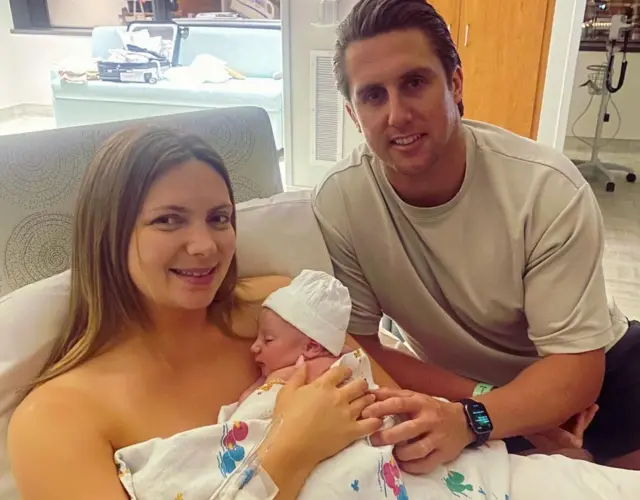
Pie de foto, El bebé Theo fue operado mientras aún estaba en el útero de Maisie Savage.Información del artículo
Una mujer embarazada fue sometida a una cirugía pionera en un feto para corregir con éxito un defecto congénito de su bebé mientras aún estaba dentro del útero.
Maisie Savage, originaria de Londres, fue operada por médicos en Estados Unidos cuando tenía 26 semanas de embarazo.
El pequeño Theo, que ahora tiene 5 meses y está creciendo sano y fuerte, padecía gastrosquisis, una afección en la que el ombligo no se desarrolla correctamente, lo que provoca que los intestinos crezcan externamente.
Los médicos expusieron parcialmente el útero de su madre y luego, mediante cirugía mínimamente invasiva, volvieron a introducir sus órganos en el abdomen.
Theo fue el tercer bebé del mundo en beneficiarse del primer ensayo clínico de este tipo.
Fuente de la imagen, Maisie Savage
Pie de foto, Theo se convirtió en el primer bebé británico en ser operado en el útero para corregir una gastrosquisis compleja.
Maisie, de 29 años, y el padre de Theo, Josh French, de 36, ambos profesores, afirman sentirse enormemente aliviados por el éxito de esta cirugía pionera.
“Es un pequeño milagro, ¿verdad?”, le dijo Maisie a la BBC.
Pero ambos saben que las cosas podrían haber sido muy diferentes.
Cada año, este grave defecto congénito afecta a uno de cada 3.000 bebés en Reino Unido. En el mejor de los casos, los bebés pueden requerir semanas en cuidados intensivos, alimentación por sonda o vía intravenosa y cirugía correctiva.
En los casos más complejos, como el de Theo, las consecuencias son mucho más graves, con hasta seis meses en cuidados intensivos neonatales, múltiples cirugías, alimentación intravenosa durante un máximo de dos años y un posible trasplante intestinal.
Incluso con el más alto nivel de atención médica, uno de cada 10 bebés morirá.
Estado de “shock”
Los padres de Theo inicialmente no tenían ni idea de que algo anduviera mal con su hijo en el feto.
“Antes de la ecografía de las 20 semanas, estábamos muy emocionados por tener una imagen de nuestro bebé”, dijo Josh. “En ese momento no sabíamos que iba a ser un niño”.
Josh añadió que descubrir que Theo tenía gastrosquisis había sido un shock y “algo increíblemente aterrador”.
A las 24 semanas de gestación, los médicos especialistas del Great Ormond Street Hospital (GOSH) de Londres habían estado preparando a los futuros padres, Maisie y Josh, para lo que serían los primeros seis meses de vida de Theo.
Sin embargo, tras descubrir que padecía una afección más grave, la gastrosquisis compleja, los médicos lo derivaron al Hospital Infantil de Texas, en Houston.
Allí, un equipo de cirujanos fetales y pediátricos, liderado por el doctor Michael Belfort, había estado llevando a cabo un ensayo clínico pionero para reparar la gastrosquisis compleja antes del nacimiento.
Belfort, el responsable clínico del ensayo, ya había sido pionero en un procedimiento quirúrgico similar en el útero de bebés con espina bífida.
Fuente de la imagen, Maisie Savage
Pie de foto, Tras la operación, Theo llegó a término y nació en Texas.
Los médicos le dijeron a Maisie que tendría que viajar a Texas de inmediato y permanecer allí durante el resto de su embarazo. “Fue una decisión muy difícil”, recordó la madre.
Como parte del ensayo clínico, primero tuvo que viajar al Hospital de Lovaina, en Bélgica, donde los especialistas debían administrarle a Maisie una inyección de Botox a través del útero hasta la pared abdominal de Theo, para relajar los músculos y facilitar la reparación.
Posteriormente, la familia viajó a Texas, donde se realizó la operación en noviembre del año pasado, cuando el embarazo estaba por las 26 semanas.
Josh contó que la espera mientras los médicos operaban a Maisie fue angustiante. “Aquel día se me hizo eterno, como una semana”, dijo. “La espera y la incertidumbre de no saber exactamente qué pasaba en cada etapa”.
En el procedimiento, se expuso parcialmente el útero de Maisie para colocarlo en la posición adecuada, se drenó el líquido amniótico y se reemplazó con dióxido de carbono (CO2) para ampliar el espacio quirúrgico.
Mediante cirugía mínimamente invasiva, los órganos de Theo se reintrodujeron suavemente en su abdomen, que posteriormente se cerró con puntos de sutura.
A Maisie le quedó una cicatriz del doble del tamaño de una incisión de cesárea. Pero a diferencia de otras mujeres que se recuperan de una cesárea, ella aún tenía un bebé que crecería dentro de ella durante otras 14 semanas.
Ella comentó que Theo a menudo la pateaba por dentro, golpeándole la cicatriz y causándole dolor. “Fue una recuperación difícil”, dijo Maise. “Pero valió la pena”.
La operación fue un éxito total y Theo llegó a término y nació en febrero mediante parto vaginal en Texas.
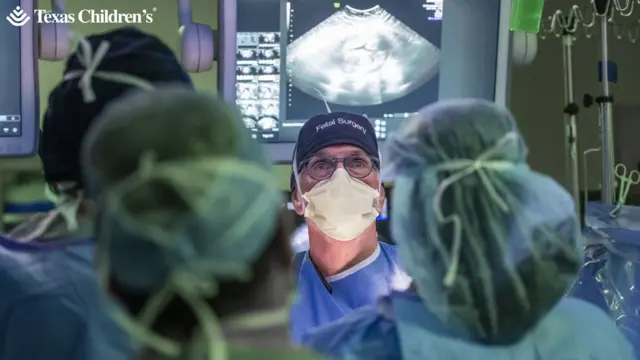
Belfort, jefe de obstetricia y ginecología del Texas Children’s Hospital, reconoció que él y su equipo están muy contentos con los resultados obtenidos hasta el momento.
“La madre, el bebé, la cirugía, el momento de la cirugía, el hecho de que no tuviéramos ninguna complicación durante la cirugía fetal ni después de la cirugía fetal, simplemente extraordinario”.
Fuente de la imagen, Texas Children’s Hospital
Pie de foto, Belfort dijo estar asombrado por los resultados de la cirugía.
Alianza a futuro
Si el ensayo resulta exitoso, Paolo de Coppi, profesor de Cirugía Pediátrica en el GOSH y jefe de células madre y medicina regenerativa en el University College de Londres, realizaría el procedimiento en el Reino Unido.
“Esperamos poder ofrecer esto a los pacientes a mayor escala muy pronto”, dijo.
Belfort se mostró entusiasmado con la colaboración y afirmó que la unión de Texas Children’s y GOSH formará un equipo formidable.
Y Belfort ya está pensando en lo que puede hacer a continuación.
“El interior del útero se ha convertido en un nuevo espacio quirúrgico para la innovación”, afirmó.
“La espina bífida y la gastrosquisis son solo dos ejemplos, pero creo que podríamos realizar ciertas cirugías cardíacas en el útero, y también algunas cirugías pulmonares”.
Fuente de la imagen, BBC News
Pie de foto, Maisie, Josh y Theo ya han vuelto a la normalidad en casa.
De vuelta en Londres, Maisie comentó que Theo está evolucionando de maravilla.
“Todo lo que hicieron revirtió por completo lo que podría haber sido un comienzo de vida realmente horrible, y él es simplemente maravilloso. Es un bebé completamente normal, en esencia”.
“Ambos nos sentimos increíblemente afortunados”, agregó Josh. “El impacto que han tenido en nosotros como familia es increíble. Nos hicieron sentir muy bienvenidos, desde el equipo de Great Ormond Street hasta el doctor Belfort y su equipo”.
“Mientras estuvimos allí, el nivel de atención fue increíble, e hicieron que un momento muy traumático de nuestras vidas fuera mucho más llevadero, y ahora tenemos a este pequeño; no podríamos estar más felices”.
Si te has visto afectado por alguno de los problemas que se tratan en este artículo, puedes encontrar información y apoyo en la Línea de Ayuda de la BBC.
Este artículo fue escrito originalmente en inglés y usamos una herramienta de inteligencia artificial para traducirlo. Un periodista de la BBC revisó el texto antes de su publicación. Más información sobre cómo usamos IA.
Descarga la nueva app del BBC World Service. Elige BBC News Mundo y recibe alertas de noticias, documentales y análisis, todo en un solo lugar. Importante: la nueva aplicación no está disponible en Reino Unido ni Estados Unidos.
Quienes han invertido alguna vez en criptomonedas lo saben bien: los monederos físicos (“cold wallets“) eran la forma ideal de protegerlos ante potenciales robos. Esos monederos siempre prometían lo mismo: que las claves que permiten mover el dinero nunca abandonan el dispositivo. Era mentira.
Catástrofe. El pasado 31 de julio, cientos de propietarios de los monederos ColdCard vieron cómo en apenas 40 minutos su dinero desapareció de sus dispositivos. El atacante no tuvo que tener acceso físico a los dispositivos, ni infectarlos ni conectarse a ellos. Le bastó hacer algo que debería haber sido imposible: adivinar las claves para robar ese dinero. El robo ha afectado a 1.367 bitcoins, unos 89 millones de dólares a los precios actuales, que se han sustraído de 4.585 direcciones de monederos distintos. Es un robo “menor” comparado con otros en el pasado, pero lo significativo es cómo se ha producido.
La caja fuerte seguía cerrada. El ataque ni siquiera rompió el aislamiento implícito de los monederos ni tampoco extrajo claves almacenadas en ellos. El fallo era aún más grave: se produjo en el momento en el que el dispositivo creó esas claves. Un monedero de bitcoin genera primero una semilla, una sucesión de datos aleatorios. De ella se derivan las claves privadas y las direcciones. Si esa semilla es realmente impredecible, probar todas las posibilidades resulta inviable, incluso para los mejores supercomputadores del planeta. El problema es qeu si la semilla no lo es, da igual que la caja fuerte (el monedero) esté totalmente aislada y cerrada.
El azar que dejó de serlo. En 2021 los responsables de ColdCard cambiaron parte del código empleado para generar semillas al integrar una biblioteca llamada libNgU. La intención era recurrir al generador físico de números aleatorios del dispositivo. Sin embargo, un error de integración hizo que el programa acabara usando como alternativa un generador seudoaleatorio de MicroPython embebido que exponía la librería libsecp256k1 y otras primitivas de bitcoin, como explican en Coinkite en un repaso técnico del desastre de seguridad que se creó en las ColdCard.
Parecía aleatorio, pero no lo era tanto. El generador alternativo tomaba datos como el identificador fijo del chip y varios registros relacionados con el reloj del dispositivo. Esos valores producen números que pueden aparentar aleatoriedad, pero que no son un recurso criptográfico suficientemente fuerte porque podían acotarse. Con suficientes conocimientos del firmware y del comportamiento del hardware, un atacante podía recrear fuera del dispositivo una lista de semillas candidatas.
Fuerza bruta. En los modelos Mk2 y Mk3 afectados, Coinkite estima que el espacio efectivo para generar semillas se reducía a 40 bits. En los Mk4 y Mk5 había un elemento de entropía más, y las semillas crecían hasta los 72 bits. El análisis de los expertos de Block reveló cómo un problema en ese firmware en realidad hacía que las semillas se limitasen a tan solo 32 bits, lo que en esencia hacía que “adivinar” las claves ya no fuese virtualmente imposible, sino tan solo cuestión de potencia de cálculo y tiempo.
Adivinando claves era cuestión de minutos. Esos 32 bits dan lugar a unas 4.300 millones de posibles claves distintas. Es una cifra enorme si un ser humano tuviera que comprobarlas todas, pero también es un número totalmente asumible para máquinas capaces de realizar cálculos masivos. Para cada semilla, el atacante podía averiguar las posibles direcciones y luego compararlas con la cadena de bloques de bitcoin. Cuando una coincidencia mostraba fondos, se obtenía a continuación la clave para moverlos. Daba igual que el monedero físico estuviese a buen recaudo incluso en una caja fuerte: el atacante ni siquiera necesitaba acceso a él porque con esos datos era como si tuviera ese monedero en sus manos.
Atraco por oleadas. La primera gran operación de transferencia de bitcoins vació 1.082,65 BTC de 1.196 monederos en apenas 41 minutos el 31 de julio. Nuevos barridos acabaron elevando el total a 1.367 bitcoin, cerca de 89 millones de dólares. El estudio de Galaxy Research revela que lo más probable es que el responsable fuera un único atacante, aunque puede que simplemente varios atacantes diferentes exploraran el mismo conjunto de claves débiles.
Actualizar no basta. Coinkite ya ha publicado actualizaciones de firmware que corrigen el problema para los dispositivos afectados. Instalarlo solo evita que se creen nuevas semillas defectuosas, pero no transforma en segura una semilla generada anteriormente. La recomendación de los creadores de ColdCard es la de actualizar primero, crear luego una semilla completamente nueva y trasladar los fondos.
La paradoja del código abierto. Los responsables de la ColdCard reconocen que su código era público y que las revisiones anteriors comprobaron la presencia del generador físico de números aleatorios y semillas, pero no siguieron con detalle qué implementación usaba realmente la función que creaba las semillas. Ellos mismos confiesan haber usado un modelo avanzado de IA para intentar analizar la seguridad de su software, pero el problema no fue detectado. Se especula con que alguien pudo utilizar un modelo de IA para revisar versiones antiguas y localizar el fallo, aunque no hay pruebas de que la brecha de seguridad se haya encontrado de esa forma.
2 ago (Reuters) – La red eléctrica de Cuba colapsó a última hora del domingo, informó el operador estatal, dejando a oscuras a la isla de unos 10 millones de habitantes, en momentos en que los apagones son cada vez más frecuentes.
El apagón se produce después de tres cortes de energía a nivel nacional ocurridos en julio y coincide con el bloqueo petrolero impuesto por Estados Unidos, que agrava la presión sobre la envejecida infraestructura energética de la isla.
La Unión Eléctrica de Cuba no ofreció más detalles sobre la situación en sus publicaciones en X y Facebook.
La presión sobre el sistema eléctrico ha aumentado mientras la isla enfrenta dificultades para asegurar importaciones de combustible.
El país perdió una fuente clave de suministro tras el bloqueo petrolero impuesto por el presidente estadounidense Donald Trump, luego del derrocamiento del presidente venezolano Nicolás Maduro.
Venezuela había sido durante mucho tiempo el principal proveedor de petróleo de Cuba, mientras que las importaciones procedentes de México también se han interrumpido ante el aumento de la presión estadounidense.
La crisis eléctrica coincide con una cautelosa apertura del sector energético cubano, estrictamente controlado por el Estado, impulsada por la escasez de combustible y las severas sanciones de Estados Unidos.
La Habana autorizó recientemente su primera empresa de importación de combustible con respaldo extranjero y permitió que cerca de 200 empresas cubanas participaran en la distribución mayorista de combustibles.
(Reporte de Ananya Palyekar en Bengaluru; edición de Christian Schmollinger y Clarence Fernandez)
Cuba sufrió este domingo un nuevo apagón nacional de su red eléctrica, informó la empresa estatal de energía de la isla, afectada por la escasez de combustible debido al bloqueo petrolero estadounidense.
Cuando las luces se apagaron repentinamente en La Habana, los residentes que estaban en las calles para buscar alivio por el calor se lamentaron por una nueva caída del suministro.
La estatal Unión Eléctrica de Cuba (UNE) dijo en X que hubo una “desconexión total” del sistema eléctrico nacional, sumiendo al país en la oscuridad.
El gobierno anunció posteriormente que se activaron las medidas para restablecer el servicio eléctrico.
“Ya comenzaron a activarse todos los protocolos para el restablecimiento del Sistema Eléctrico. A las 22:43 de esta noche (02H43 GMT de lunes) ocurrió una desconexión total”, informó en X el Ministerio de Energía y Minas de Cuba.
La isla ha sufrido persistentes cortes debido al envejecimiento de sus plantas y a un embargo energético de Estados Unidos que detuvo las entregas regulares de combustible, necesario para abastecer las centrales eléctricas.
Este es el último de una serie de colapsos totales de la red eléctrica. Apenas 24 horas antes, cinco de las 15 provincias del país se quedaron sin energía.
Desde que comenzó el año, la isla de 9,4 millones de habitantes ha registrado seis apagones generalizados. Desde finales de 2024, los cortes masivos suman 11.
El gobierno cubano acusa a Washington de ser responsable de la situación crítica del sistema eléctrico, mientras que Estados Unidos considera que la crisis energética cubana se debe a una mala gestión económica interna.
Las siete plantas termoeléctricas que constituyen la columna vertebral de la red nacional cubana llevan más de 40 años en funcionamiento y se encuentran en distintos grados de deterioro.
– Agotados –
Los cortes de energía han hecho que una vida normal en la isla sea casi imposible, ya que cada apagón también implica que el flujo de agua se reduzca y que los ventiladores se detengan por completo.
Los cubanos no dudan en admitir que están agotados por las constantes interrupciones.
Washington, que mantiene un embargo a la isla desde 1962, impuso en enero un bloqueo petrolero a Cuba por orden del presidente Donald Trump.
Estados Unidos solo ha permitido la llegada de un tanquero ruso con 100.000 toneladas de crudo en marzo, lo que ha empeorado la crisis energética. Sin embargo, esas reservas ya se agotaron.
Además del bloqueo petrolero, la administración Trump ha intensificado las sanciones contra empresas estatales cubanas, lo que ha llevado a muchas compañías extranjeras a suspender sus operaciones en el país.
A finales de junio, el canciller cubano Bruno Rodríguez afirmó que las conversaciones con Estados Unidos “no muestran progresos”.
La Habana puso en marcha una serie de reformas de libre mercado para darle un impulso a la economía.
La red eléctrica de Cuba falló el domingo y provocó otro apagón en todo el país, según informó la empresa estatal de energía en una publicación en redes sociales. Cuando las luces se apagaron de repente en toda la capital, La Habana, los vecinos que estaban sentados en la calle para aliviar el calor del verano dejaron escapar un largo gemido colectivo.
Desde hace tiempo Cuba sufre cortes eléctricos rotatorios a causa del envejecimiento de las instalaciones y del embargo energético de Estados Unidos, que ha frenado el suministro regular de combustible a las centrales. La empresa estatal UNE aseguró que se produjo una “desconexión total” del sistema eléctrico nacional, lo que sumió al país, incluida la capital, en una oscuridad repentina.
Se trata del último episodio de una serie de colapsos totales de la red eléctrica. Hace solo 24 horas se quedó a oscuras todo el oeste del país. Los cortes de luz han hecho que la vida cotidiana sea casi imposible, y cada apagón implica además que el suministro de agua se reduzca a un hilo y los ventiladores de techo se detengan poco a poco.
Unos hombres se sientan sobre un coche durante un apagón en La Habana, 14 de julio de 2026 – AP Photo
Es una presión creciente para una sociedad acostumbrada a la adversidad pero atrapada ahora en una crisis de meses que no tiene un final claro a la vista. Los vecinos de las zonas más afectadas han desahogado su frustración prendiendo fuego a montones de basura o haciendo sonar cacerolas.
El Ministerio de Energía informó de que ya se habían activado los protocolos para reactivar la red eléctrica. Por su parte, Washington solo ha autorizado la llegada de un petrolero ruso, con 100.000 toneladas de crudo, que arribó en marzo. Esas reservas ya se han agotado.
Estados Unidos también ha imputado al expresidente Raúl Castro, hermano del líder revolucionario Fidel Castro, por el derribo de dos aviones civiles hace tres décadas. Las conversaciones entre La Habana y Washington parecen haber avanzado muy poco.
La Habana ha puesto en marcha una serie de reformas de libre mercado para dar un impulso a la economía.
Luis Díaz ha vuelto a la oficina. Después de pasar el trago amargo de su desconcertante Mundial 2026, está listo para una nueva temporada en Bayern Múnich, su casa, su lugar feliz, el que apostó como nunca y merecidamente se benefició de su talento desde el primer día.
Uno de los mejores extremos del mundo estrena look en la temporada en la que aspira, como reto más ambicioso, a poner en su vitrina la tan esquiva Orejona, que reconoce al mejor equipo de la Champions League.
Luis Díaz vuelve a la oficina: reto y duro itinerario en Bayern Múnich
Viene de un debut por el que no apostaban ni los hombres fuertes del Bayern que fueron por él hasta Liverpool con un maletín cargado con poco más de 70 millones de euros.
Luis Díaz Foto:Bayern Múnich
Fue pieza clave en la tarea de arrasar con los títulos en Alemania y llegar hasta el último instante de la semifinal de la Champions League vivo, marginado solo por el incontenible PSG de Luis Enrique. Fue pulmón por la banda, 9 falso, sacrificio en el retroceso y el dueño del caos que su entrenador, Vincent Kompany, le reconoce como una de sus principales virtudes.
Fue, por mucho, el fichaje del año en Alemania, en Bayern, en el mercado europeo del último año. Díaz disputó 51 de los 55 partidos oficiales del Bayern en la temporada 2025/ 2026, siendo titular en 46 encuentros y con un balance de 26 goles y 23 asistencias entre todas las competencias.
Luis Díaz Foto:Bayern Múnich
En Bundesliga tuvo un impacto enorme en ataque. Bayern marcó 122 goles en el campeonato y Lucho participó en 32 de ellos gracias a sus 15 anotaciones y 17 asistencias. Lo natural es que haya una expectativa enorme y una cálida bienvenida a un jugador con semejante influencia.
Calendario agotador
El primer compromiso en la agenda, en esta segunda temporada en Bayern, será la Audi Summer Tour en Corea del Sur y Hong Kong, entre el primero y el 8 de agosto. En este certamen enfrentará mañana al Jeju SK FC y el viernes a Aston Villa.
Luis Díaz Foto:Bayern Múnich
Como Kane y Olise jugaron el octavo partido con sus selecciones en el Mundial aún no se incorporan, lo que deja a Díaz como la gran figura de ataque en la gira.
De vuelta de territorio asiático, el colombiano tendrá otro amistoso contra RB Leipzig, el 15 de agosto, en el Allianz Arena, antes de disputar el primer título de la temporada. El 22 de agosto, Bayern visitará al Borussia Dortmund en el Signal Iduna Park para decidir el campeón de la Supercopa de Alemania, que enfrenta a los mejores del curso anterior. Ya el guajiro ganó este trofeo en su aterrizaje en Múnich.
Retos ambiciosos
El desafío pasa por repetir el triplete alemán, con los títulos de Bundesliga, DFB-Pokal y Supercopa y apuntar a la revancha en la Champions League, de la que fue marginado por el campeón PSG.
Luis Díaz Foto:Bayern Múnich
La competencia oficial en la liga alemana empieza el 28 de agosto contra Stuttgart, en el Allianz Arena. Volver a un ritmo descollante es lo que se espera de un hombre clave del tridente, con Kane, Olise y un par de nuevas incorporaciones.