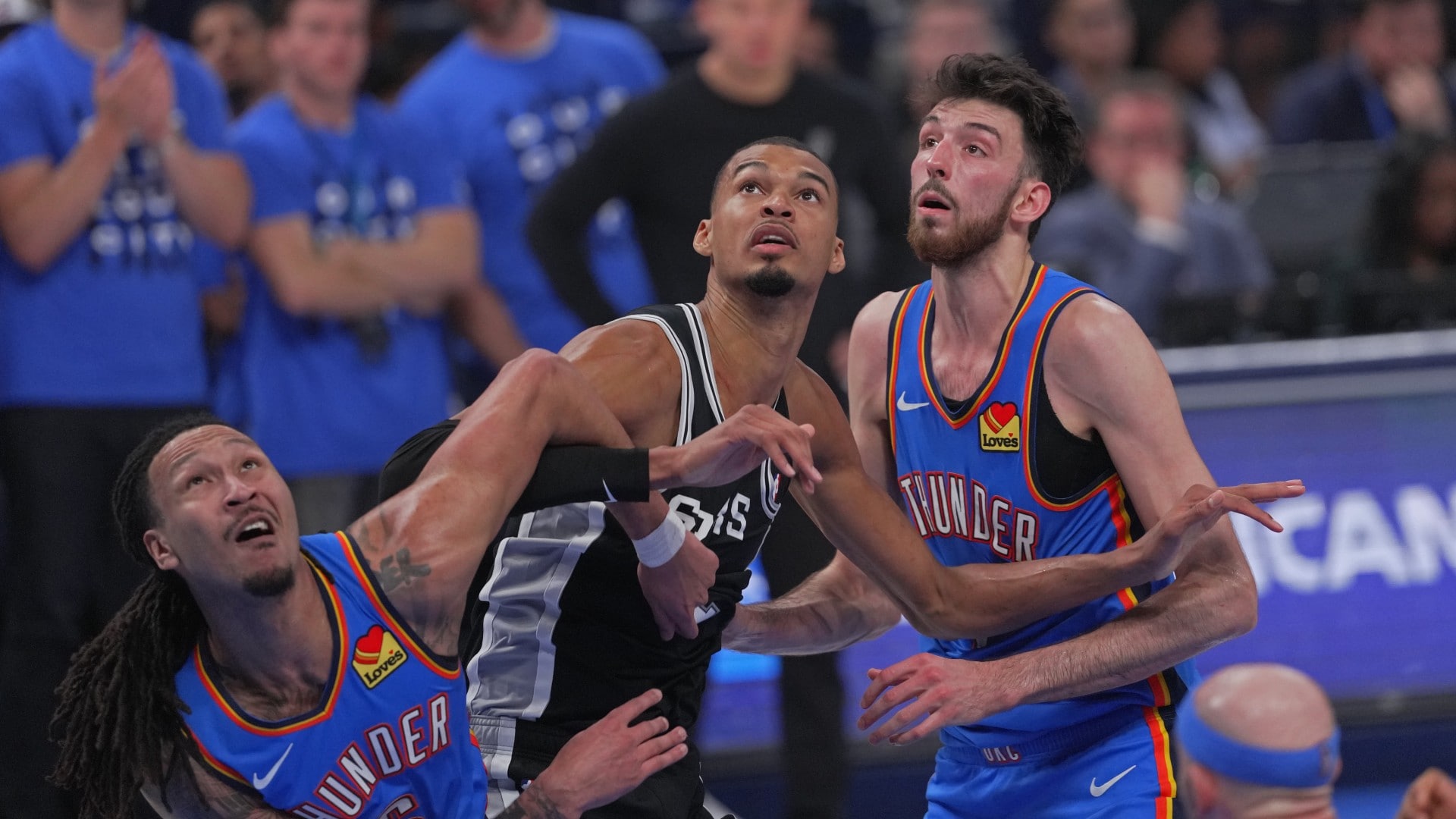
The Spurs and Thunder battled through a contested seven-game series in the 2026 Western Conference Finals.
• Download the NBA App
• 2026 Free Agent Tracker
• Every reported deal for all 30 teams
The Eastern Conference may be the deeper when it comes to teams that could finish with winning records in the 2026-27 season. But the West still has the San Antonio Spurs and Oklahoma City Thunder.
Over the last two seasons (and including playoffs), the Thunder have outscored their opponents by an amazing 11.2 points per game. Simply, they’ve had two of the best seasons in NBA history. But they met their match last season, with the Spurs winning eight of the 12 head-to-head matchups, including Game 7 of the Western Conference finals in Oklahoma City.
The Thunder have had to shed some of their depth, but they should be getting more games and minutes from Jalen Williams than they did last season, while seeing some improvement from their young core. Speaking of young cores, the Spurs’ Dylan Harper, Stephon Castle and Victor Wembanyama are just 20, 21 and 22 years old, respectively.
So it looks like we’re going to get another epic battle between Oklahoma City and San Antonio, both in the regular season and in the playoffs. But is there a third Western Conference team that can challenge the top two? Can a Play-In or Lottery team from last season climb into the top six?
Here’s a crack at how the Western Conference stacks up as we enter the month of August, with some offseason business still to be done.
Note: For these offseason rankings, we’re looking at each conference separately, with the Eastern Conference rankings having been published last week. All stats refer to the 2025-26 regular season unless otherwise noted. Last week’s rank is based on how team’s finished in the playoffs, Play-In and regular season.
Previously…
OffRtg: Points scored per 100 possessions (League Rank)
DefRtg: Points allowed per 100 possessions (League Rank)
NetRtg: Point differential per 100 possessions (League Rank)
The league averaged 114.8 points scored per 100 possessions and 100.2 possessions (per team) per 48 minutes last season.
NBA.com’s Power Rankings, released every Monday during the season, are just one man’s opinion. If you have an issue with the rankings, or have a question or comment for John Schuhmann, contact him via Bluesky.

Last Week:2↑
2025-26 record: 64-18
OffRtg: 117.6 (7) DefRtg: 106.5 (1) NetRtg: +11.1 (1)
Key addition: Aday Mara
Key departures: Lu Dort, Isaiah Joe, Aaron Wiggins
Three numbers to know…
- The Thunder allowed 8.3 fewer points per 100 possessions than the league average (114.8), which was the second best differential for any team in the 30 seasons for which we have play-by-play data, topped by only that of the 2003-04 Spurs.
- Shai Gilgeous-Alexander scored 1.18 points per possession as a pick-and-roll ball-handler, the best mark for a player with at least 200 ball-handler possessions in the 22 seasons of Synergy tracking. He was the first player in the 13 seasons of camera-tracking data to shoot 55% or better on at least 500 pull-up 2-point attempts.
Key question: How much does depth matter?
The Thunder have had the league’s top-ranked bench (by wide margins) in each of the last two seasons. But they’ve just salary-dumped guys who ranked second, fifth and sixth on the team in total minutes over those two years. Both Ajay Mitchell and Cason Wallace appear ready for bigger roles, but Gilgeous-Alexander probably won’t be the only Thunder player averaging at least 30 minutes this season, and it’ll be tougher to be extra cautious with Alex Caruso’s playing time.
It may all come down to how well the Thunder match up with the Spurs, with the 107.9 points per 100 possessions they scored in the conference finals being their worst offensive mark for any of their nine playoff series in the last three years. But they basically had Jalen Williams for just one of those seven games, and he could make up for much of the lost depth if he’s fully recovered from his multiple injuries over the last 16 months.

Last Week:1↓
2025-26 record: 62-20
OffRtg: 118.7 (3) DefRtg: 110.4 (3) NetRtg: +8.4 (3)
Key addition: Tobias Harris
Key departures: N/A
Three numbers to know…
- The Spurs were one of two teams (the Celtics were the other) to rank in the top five on both ends of the floor. They were 11.2 points per 100 possessions better than they were in 2024-25 (minus-2.8, 22nd), with that being the fifth biggest season-to-season jump for any team in the last 30 years.
- Stephon Castle averaged 8.9 assists per 36 minutes, up from 5.5 as a rookie. That was the biggest jump among 290 players who played at least 500 minutes in each of the last two seasons. He had 130 total assists to Victor Wembanyama, a rate of 3.9 per 36 minutes on the floor together. That was the highest rate among 56 combinations where one player had at least 75 total assists to the other.
- The Spurs were 16.4 points per 100 possessions better with Wembanyama on the floor (plus-17.0) than they were with him off the floor (plus-0.6). That was the biggest on-off differential among 263 players who played at least 1,000 minutes for a single team.
Key question: How much more is Dylan Harper going to play?
The Spurs are running it back, with players under contract accounting for 94% of their 2025-26 regular-season minutes, the league’s highest rate. They actually gained a rotation player (Harris) without losing any. But Harper needs to be on the floor more than he was last season, when he ranked eighth on the team at 22.6 minutes per game. He averaged 26.8 in the playoffs, but that was still 6.7 fewer minutes per game than De’Aaron Fox.
The team was at its best in the regular season (plus-27.0 per 100 possessions) with Harper and Wembanyama on the floor together, but they were the Spurs’ 33rd most-used combination at just 560 total minutes. Might they make another big step forward if Harper is improved and playing more?

Last Week:5↑
2025-26 record: 54-28
OffRtg: 121.2 (1) DefRtg: 116.0 (21) NetRtg: +5.2 (7)
Key addition: Marvin Bagley III
Key departures: Tim Hardaway Jr., Jonas Valančiūnas
Notable free agents: Bruce Brown, Peyton Watson
Three numbers to know…
- The Nuggets have ranked in the top seven offensively in each of the last 10 seasons, with last season (when they scored 6.4 points per 100 possessions more than the league average) being their best offensive season in that stretch. They were the only team that ranked in the top five in field goal percentage, 3-point percentage and free throw percentage.
- Cam Johnson had a usage rate of 14.4%, down from 22.4% with Brooklyn in 2024-25. That was the biggest drop among 290 players who played at least 500 minutes in each of the last two seasons.
Key question: How much depth are they losing?
Hardaway and Valančiūnas are gone, and keeping Watson may lead to another rotation player being traded. Depth has always been an issue with the Nuggets (they’ve been outscored by 7.7 points per 100 possessions with Jokić off the floor over the last five years) and their depth is taking more hits. They finished 2025-26 with a league-high 10 players who shot the league average or better from 3-point range, and they have just six under contract for ’26-27, with three of the other four – Brown, Watson and Jalen Pickett – still free agents.
The Nuggets can hope that Aaron Gordon is healthier after playing in only 36 games in the regular season and in only three of their six playoff games. They need to get back to being an average-ish on defense, and Gordon’s health is obviously the most important thing in that regard. They can also hope for a healthier Christian Braun (44 games in the regular season), who could also get back to shooting from 3-point range as well as he did through his first three seasons (38.4%) after dropping to 30.1% last year.

Last Week:3↓
2025-26 record: 53-29
OffRtg: 117.0 (10) DefRtg: 115.5 (20) NetRtg: +1.5 (14)
Key additions: Quentin Grimes, Jaden Hardy, Walker Kessler, Kevon Looney, Sandro Mamukelashvili, Collin Sexton
Key departures: Deandre Ayton, Rui Hachimura, Jaxson Hayes, LeBron James, Luke Kennard, Marcus Smart
Three numbers to know…
- The Lakers were 53-29 with the point differential of a team that was 46-36, in part because they were a league-best 22-8 (starting the season with 13 straight wins) in games that were within five points in the last five minutes. They scored 129.3 points per 100 clutch possessions, the second best mark for any team in the 30 seasons of play-by-play data.
- They outscored their opponents by 3.6 points per game at the free throw line, leading the league in free throw differential for the fourth straight season.
- They outscored opponents by 10.1 points per 100 possessions in 532 minutes with Luka Dončić and Austin Reaves on the floor without James.
Key question: Can they defend?
It’s a restart of the Dončić era in L.A., with the Lakers set to return only 42% of their regular-season minutes from last season, easily the league’s lowest rate. (The Clippers are the only other team currently under 50%.) They’ll be elite offensively with a full season from Dončić, but their biggest issue is the same as it was last season, when they had their second worst defensive season (they allowed 0.7 points per 100 possessions more than the league average) in the last nine years. Defending opposing perimeter stars is tough when you’re starting Dončić and Reaves at the guard positions.
Kessler should be able to clean things up better than last year’s centers, but the length and mobility they need to defend at a high level is coming from guys – Matisse Thybulle and Ziaire Williams – who don’t offer much offensively and might see limited minutes in the playoffs.

Last Week:6↑
2025-26 record: 52-30
OffRtg: 117.5 (8) DefRtg: 112.1 (6) NetRtg: +5.4 (6)
Key additions: Bogdan Bogdanović, Marcus Smart
Key departure: Josh Okogie
Key return: Fred VanVleet
Three numbers to know…
- The Rockets have led the league in rebounding percentage in each of the last two seasons, with their 54.5% last season being the highest for any team in the 30 years of play-by-play data.
- They were tied with the Pistons for the fewest losses (they were 30-7) in games that weren’t within five points in the last five minutes. They had the second biggest differential between their record in non-clutch games and their record in games that were within five in the last five (22-23).
- Amen Thompson shot 61.2% in the paint, but had an effective field goal percentage of just 30.3% on shots from outside the paint. That was the biggest such differential among 149 players with at least 200 field goal attempts both in and outside the paint.
Key question: How important is VanVleet?
The Rockets desperately needed a point guard last season. Not only did they rank 27th in turnover rate (15.7 per 100 possessions), but, on average, they were the slowest team to cross midcourt in the 13 seasons of tracking data. VanVleet will get them into their offense a little quicker, while also giving them some much-needed perimeter shooting. The Rockets have just three of the 154 players – Kevin Durant, Reed Sheppard and Jabari Smith Jr. – who shot the league average (36.0%) or better on at least 100 3-point attempts last season.
This team was better than its record, finishing with the league’s sixth best point differential, that of a team that was 56-26. And it destroyed the Lakers in the possession game (averaging 17 more shot opportunities) in the first four games of the first round, but was just unable to make shots in the first three. Some improvement with offensive execution could make all the difference.

Last Week:4↓
2025-26 record: 49-33
OffRtg: 115.6 (13) DefRtg: 112.5 (8) NetRtg: +3.1 (10)
Key additions: LaMelo Ball, Josh Green, Trey Lyles
Key departures: Mike Conley, Julius Randle, Naz Reid
Three numbers to know…
- The Wolves are one of two teams (the Celtics are the other) that have ranked in the top 10 defensively in each of the last four seasons. But last season (when they allowed 2.3 fewer points per 100 possessions than the league average) was their worst defensive season of the last three.
- Ayo Dosunmu (from 32.8% to 43.9%) and Jaden McDaniels (from 33.0% to 41.2%) saw the biggest and third biggest jumps in 3-point percentage from 2024-25 to ’25-26 among 222 players with at least 100 3-point attempts in each of the last two seasons.
- Anthony Edwards had an effective field goal percentage of 64.7% with the game within five points in the last five minutes of the fourth quarter or overtime. That was the best clutch effective field goal percentage for a player with at least 75 field-goal attempts (491 total instances) across the 30 seasons for which we have clutch data.
Key question: Can Rudy Gobert continue to hold up?
Ball should help Edwards, who shot 69-for-139 (49.6%) on catch-and-shoot 3-pointers, the best mark among 308 players with at least 75 catch-and-shoot attempts last season and much better than he shot (35.3%) on pull-up 3s. Increase the percentage of his attempts that come off the catch to around 50% and Edwards is a much more efficient player. Ball’s teammates had an effective field goal percentage of 61.8% on his passes last season, the third-highest mark among 139 players who were the passer on at least 500 shots.
But with the departures of Randle and Reid, the Wolves are more dependent on Gobert than they’ve ever been. He’s obviously the biggest reason they’ve been so good defensively over the last four years, in which he’s averaged 73.5 games played. But he’ll be entering Year 14 at the age of 34, and the only other centers on the roster – Joan Beringer and Rocco Zikarsky – played a total of 23 minutes over the Wolves’ 12 playoff games.

Last Week:7
2025-26 record: 45-37
OffRtg: 114.2 (17) DefRtg: 112.9 (9) NetRtg: +1.4 (15)
Key additions: Miles Bridges, Luke Kennard
Key departures: Grayson Allen, Royce O’Neale
Three numbers to know…
- The Suns were the league’s most improved team (by a wide margin) in regard to the possession game. They averaged 3.1 more shot opportunities than their opponents, the league’s third best differential last season and up from 4.3 fewer than their opponents (third worst) in 2024-25. But they lost the possession game in three of their four games as they got swept by the Thunder in the first round of the playoffs.
- Last season was their second-best defensive season (1.9 fewer points allowed per 100 possessions than the league average) in the last 25 years. They saw the league’s biggest jump in opponent turnover rate (see note above) and its second biggest drop in opponent 3-point percentage.
- Dillon Brooks had a usage rate of 27.9%, up from 17.6% with Houston in 2024-25. That was the biggest jump among 290 players who played at least 500 minutes in each of the last two seasons.
Key question: Is more Jalen Green a good thing?
After playing all 82 in each of the previous two seasons, Green was available for just 32 regular-season games last year, logging just 291 total minutes (regular season, Play-In and playoffs combined) alongside both Brooks and Devin Booker. But the offense worked with all three on the floor, with the Suns scoring an efficient 122.6 points per 100 possessions in those minutes, even though 37% of them came against the Thunder. With Brooks’ ability to play the four, they didn’t necessarily have to play without a real point guard, and Collin Gillespie was also on the floor for 64 (60%) of the trio’s playoff 107 minutes.
The Suns can certainly compete with the second tier of Western Conference teams if they can score that efficiently in a larger sample size with a healthier Green, while also continuing to win the possession game. It’s a huge year for the Suns-Green relationship, with him having a player option for 2027-28.

Last Week:15↑
2025-26 record: 22-60
OffRtg: 112.7 (22) DefRtg: 120.8 (29) NetRtg: -8.2 (27)
Key additions: Josh Okogie, Darryn Peterson
Key departure: Walker Kessler
Three numbers to know…
- The Jazz are the third team in the 30 years for which we have play-by-play data to rank in the bottom two on defense in three straight seasons. They’ve ranked last in both transition points allowed and 3-pointers allowed in all three.
- Their opponents took 45.1% of their shots, the league’s highest opponent rate, from 3-point range. And 59% of their opponents’ 3-point attempts, also the league’s highest rate, were wide open.
- Lauri Markkanen scored 0.505 points per touch, the highest rate among 426 players with at least 500 total touches.
Key question: How easily can they flip the switch?
The Jazz have finished last in the Western Conference in each of the last two seasons. Will Hardy has a .326 winning percentage in his four years as head coach, and Lauri Markkanen has never made the playoffs in his nine-year career. Now, they have the talent to compete for a top-eight spot in the West. But how easy is it to turn the ship around after not caring about wins and losses for so long?
There’s obviously more room for improvement on defense, where the Jazz could take a step forward by just trying to get back in transition every once in a while. They actually allowed only 90.4 points per 100 possessions in Jaren Jackson Jr.’s 72 minutes on the floor in February (before he was shut down for the season), but there aren’t many other plus defenders on this roster. There’s more talent on offense, but how it all fits together without a natural playmaker in the starting lineup will be an interesting puzzle for Hardy to solve.

Last Week:8↓
2025-26 record: 42-40
OffRtg: 113.1 (21) DefRtg: 113.5 (12) NetRtg: -0.4 (19)
Key addition: Ja Morant
Key departures: Jerami Grant, Matisse Thybulle
Key return: Damian Lillard
Coaching change: Tiago Splitter out, Micah Nori in
Three numbers to know…
- Last season was the first in the last seven years that the Blazers had a better-than-average defense. They had the ninth-ranked defense (116.3 points allowed per 100 possessions) in games against the league’s top 10 offenses.
- According to tracking data, they ranked second in shot quality. But they were 22nd in effective field goal percentage. They ranked in the bottom five in both mid-range field goal percentage (38.0%, 26th) and 3-point percentage (34.3%, 28th).
- They averaged 18.4 second-chance points per game, the second most for any team in the 30 seasons for which second-chance points have been counted. Donovan Clingan (14.9%) and Robert Williams III (13.3%) ranked second and seventh in offensive rebounding percentage among 305 players who averaged at least 15 minutes in 40 games or more.
Key question: How is this going to work … on either end of the floor?
Talent is the most important thing, and this looks like the Blazers’ most talented roster in the last six years. But it also may be the most unbalanced roster in the league, comprised mostly of guards and centers, with Deni Avdija and Toumani Camara the only true forwards.
Avdija will be a better perimeter shooter playing more off the ball; He shot 36.0% on catch-and-shoot 3-pointers and just 25.0% on pull-up 3s last season. But his efficient trips to the line will be reduced if he’s ceding touch time to Lillard and Morant.
The Morant-Avdija combination will be lethal in transition, but transition opportunities require stops on the other end of the floor. And it will be difficult to maintain a better-than-average defense if Lillard and Morant are playing a lot of minutes, even if Jrue Holiday can hold up against opposing forwards.

Last Week:9↓
2025-26 record: 37-45
OffRtg: 113.8 (19) DefRtg: 114.4 (16) NetRtg: -0.5 (20)
Key addition(s): Yaxel Lendeborg
Key departure: Quinten Post
Three numbers to know…
- Last season was just the second time in the last 14 seasons that the Warriors had a negative point differential. It was both their third worst offensive season (they scored 0.9 fewer points per 100 possessions than the league average) and their third worst defensive season (they allowed 0.4 fewer than average) over those 14 years.
- They had the league’s highest 3-point rate, taking 49.7% of their shots from beyond the arc. They outscored their opponents by 8.3 points per game, the league’s second biggest differential, from 3-point range.
- The Warriors scored 1.13 points per chance when they set a ball-screen for Stephen Curry. That was the highest mark for any player (minimum 500 ball-screens set) in the 13 seasons of tracking data.
Key question: Will there be other trade opportunities?
Curry remains one of the most impactful players in the league, but the Warriors haven’t had enough complementary players to take advantage of his gravity on offense, and they haven’t been able to add veteran talent to guarantee him another playoff appearance. Might there be more opportunities to add another starter between now and the trade deadline?
Better health from Curry himself would keep the Warriors more competitive. His 43 games last season were the second fewest he’s played in the last 14 years, but they were 24-19 in the games he played, putting up the numbers (117.9 points scored per 100 possessions) of a top-five offense. Kristaps Porziņģis played in 16 of their final 22 games (including the Play-In), just turned 31 on Sunday, and could certainly raise the floor if the Warriors have figured out how to keep him healthy.

Last Week:12↑
2025-26 record: 26-56
OffRtg: 110.3 (27) DefRtg: 115.5 (19) NetRtg: -5.2 (22)
Key additions: Santi Aldama, Morez Johnson Jr., Zaccharie Risacher, Marcus Sasser
Key departures: Marvin Bagley III, Ryan Nembhard
Key return: Kyrie Irving
Coaching change: Jason Kidd out, Dusty May in
Three numbers to know…
- The Mavs were one of two teams (the Kings were the other) that ranked in the bottom five in both 3-point percentage (34.4%, 26th) and the percentage of their shots that came from 3-point range (35.5%, 27th).
- They had the league’s biggest differential between their effective field goal percentage in the first six seconds of the shot clock (64.1%, fifth best) and their effective field goal percentage thereafter (52.7%, 28th).
- Cooper Flagg was the eighth qualified rookie in NBA history to average at least 20 points, six rebounds and four assists per game. His 11.3 points in the paint per game were the most for a qualified rookie in the last seven years.
Key question: What becomes of Kyrie Irving?
Irving is a good offensive fit with Flagg, but he’s 15 years older than the reigning Rookie of the Year and (with a player option) can be a free agent next July. So the Mavs’ best play may be to trade the star guard at some point. First, they (and the rest of the league) need to see how well he’s recovered from the torn ACL he suffered 17 months ago.
More important in regard to the Mavs’ long-term plan is the health of Dereck Lively II, who’s played in just 43 games over the last two years and logged just 84 minutes (over six games) alongside Flagg last season. The on-court sample size isn’t big (948 total minutes), but over the last two years, the Mavs have allowed 10.0 fewer points per 100 possessions with Lively on the floor (105.9) than they have with him off the floor (115.9).

Last Week:10↓
2025-26 record: 42-40
OffRtg: 116.3 (11) DefRtg: 115.2 (18) NetRtg: +1.1 (16)
Key additions: Rui Hachimura, Keaton Wagler
Key departure: John Collins
Notable free agent: Bennedict Mathurin
Pending trade: Kawhi Leonard for Brandon Ingram, Gradey Dick and picks
Three numbers to know…
- The Clippers have had a winning record in each of the last 15 seasons, the fourth longest streak in NBA history. But last season was the second in that stretch in which they missed the playoffs, and it’s now been five years since they last won a playoff series (2021).
- They had the league’s biggest differential between their record when their opponents shot worse than the league average from 3-point range (30-9) and their record when their opponents shot the league average or better (12-31).
- They’ve ranked in the bottom three in both ball and player movement in each of the last three seasons. Last season, they ranked last in ball movement, averaging just 292 passes per 24 minutes of possession.
Key question: What is this team’s identity?
It’s kind of amazing how much the Clippers have turned over the roster in less than a year. Bradley Beal, Bogdan Bogdanović, John Collins, James Harden, Chris Paul and Ivica Zubac are all gone from the veteran-laden group that began last season with a loss in Utah.
Leonard may be gone as well, with the Clips having been 13.8 points per 100 possessions better with him on the floor (plus-7.5) than they were with him off the floor (minus-6.3) last season. That was the third biggest on-off differential among 263 players who played at least 1,000 minutes for a single team.
There’s still some talent here, and the Clippers can put together some good defensive lineups that include returnees Kris Dunn and Derrick Jones Jr. But they don’t have a lot of guys that have played a lot of minutes together, and it will be fascinating to see how they win possessions offensively. It’s certainly an opportunity for Darius Garland (11th in the league in time of possession after his Clippers debut) to put up All-Star numbers.

Last Week:11↓
2025-26 record: 26-56
OffRtg: 113.3 (20) DefRtg: 117.6 (23) NetRtg: -4.4 (21)
Key additions: N/A
Key departures: N/A
Coaching change: James Borrego out, Jamahl Mosley in
Three numbers to know…
- The Pelicans led the league in the percentage of their shots (58%) that came in the paint, but ranked 29th in field goal percentage in the paint (55.4%). They had three of the 41 players – Herb Jones, Micah Peavy and Jordan Poole – that shot worse than 50% on at least 100 shots in the paint.
- They outscored their opponents by 6.6 points per 100 possessions in 303 total minutes with Dejounte Murray on the floor with at least two of Jones, Trey Murphy III or Zion Williamson. But they were just 3-6 in games that all four played in.
- As things stand on Monday morning, the Pels are set to return 15 players, accounting for 93% of their minutes last season. That’s the league’s second highest rate, trailing only that of the Spurs (94%).
Key question: Can Williamson and Derik Queen play together?
The Pelicans basically gave up on the Williamson-Queen combo in late February. Over the last 20 games that both were available, they averaged just 5.9 minutes on the floor together, down from 14.5 prior to that. In total, the Pelicans were outscored by 11.0 points per 100 possessions in 711 total minutes with both bigs on the floor. But they’re bringing back the same group that finished 11 games out of the Play-In.
In Saddiq Bey and Yves Missi, the Pels have other useful bigs. But they should obviously try the Williamson-Queen combo again. It might not ever work defensively, but maybe the offense can be good enough to make up for that. It was on offense where they were at their best (116.2 points scored per 100 possessions) with Murray on the floor.

Last Week:13↓
2025-26 record: 25-57
OffRtg: 112.4 (23) DefRtg: 118.4 (27) NetRtg: -6.0 (24)
Key additions: Cameron Boozer, Jerami Grant, Quinten Post, Isaiah Stewart
Key departures: Santi Aldama, Ja Morant
Three numbers to know…
- The Grizzlies were 10.5 points per 100 possessions worse after the All-Star break (minus-12.8, 28th) than they were before the break (minus-2.3, 21st). That was the fifth biggest post-break drop-off for any team in the last 25 years.
- Cam Spencer shot 73-for-129 (56.6%) on wide-open 3-pointers, the second-best mark for a player with at least 100 wide-open attempts in the 13 seasons of tracking data.
Key question: How good is Ty Jerome?
Jerome averaged 31.4 points and 9.0 assists per 36 minutes last season and, over the last two years, he’s shot 43.3% from 3-point range and 54.2% on pull-up 2-pointers. He was coming off the bench in Cleveland two seasons ago and played just 339 total minutes last season, and Jerome is 10 years older than Boozer, so he doesn’t fit the optimal timeline for the Grizzlies. Still, it will be fascinating to see if he can come close to matching last season’s per-minute production in a larger sample size and earn a big pay day next Summer.
It’s also a big year for Cedric Coward, Zach Edey and Jaylen Wells, who all fit the Boozer timeline. They played just 158 minutes together last season, but the Grizzlies outscored their opponents by 66 points (20.9 per 100 possessions) in that time. If Edey can stay healthy (he played fewer minutes than Jerome last year), he could be one of the most impactful defensive players in the league.

Last Week:14↓
2025-26 record: 22-60
OffRtg: 110.6 (26) DefRtg: 120.3 (28) NetRtg: -9.7 (28)
Key addition: Darius Acuff Jr.
Key departure: DeMar DeRozan
Three numbers to know…
- The Kings were outscored by 10.0 points per game, the point differential of a team that was 16-66 and the worst differential in franchise history.
- They were outscored by 10.6 points per game from 3-point range, the worst discrepancy for any team in the last three seasons. Their 10.3 3-pointers per game were the fewest for any team in the last five seasons.
- Dylan Cardwell grabbed 14.8% of available offensive rebounds while he was on the floor. That was the second highest rate among 234 players who averaged at least 20 minutes in 40 games or more. The Kings outscored their opponents by 1.9 points per 100 possessions in 569 minutes with Cardwell and Nique Clifford on the floor together.
Key question: How good are the second-year guys?
Acuff is the most important guy on the roster, but does he have a running mate when it comes to the Kings’ long-term future? All three of last season’s rookies – Cardwell, Clifford and Maxime Raynaud – have shown some promise, but could any of the three develop into a top-six player on a good team?
Cardwell and Raynaud got opportunities, in part, because Domantas Sabonis played in only 19 games last season. But both of the rookies played some minutes alongside the veteran, and they also played 234 minutes together. So Sabonis’ return shouldn’t keep the young bigs from seeing the floor, and letting the young guys develop should obviously be the priority going forward. The phone lines are probably open in regard to the veterans that are still here.
Leave a Reply