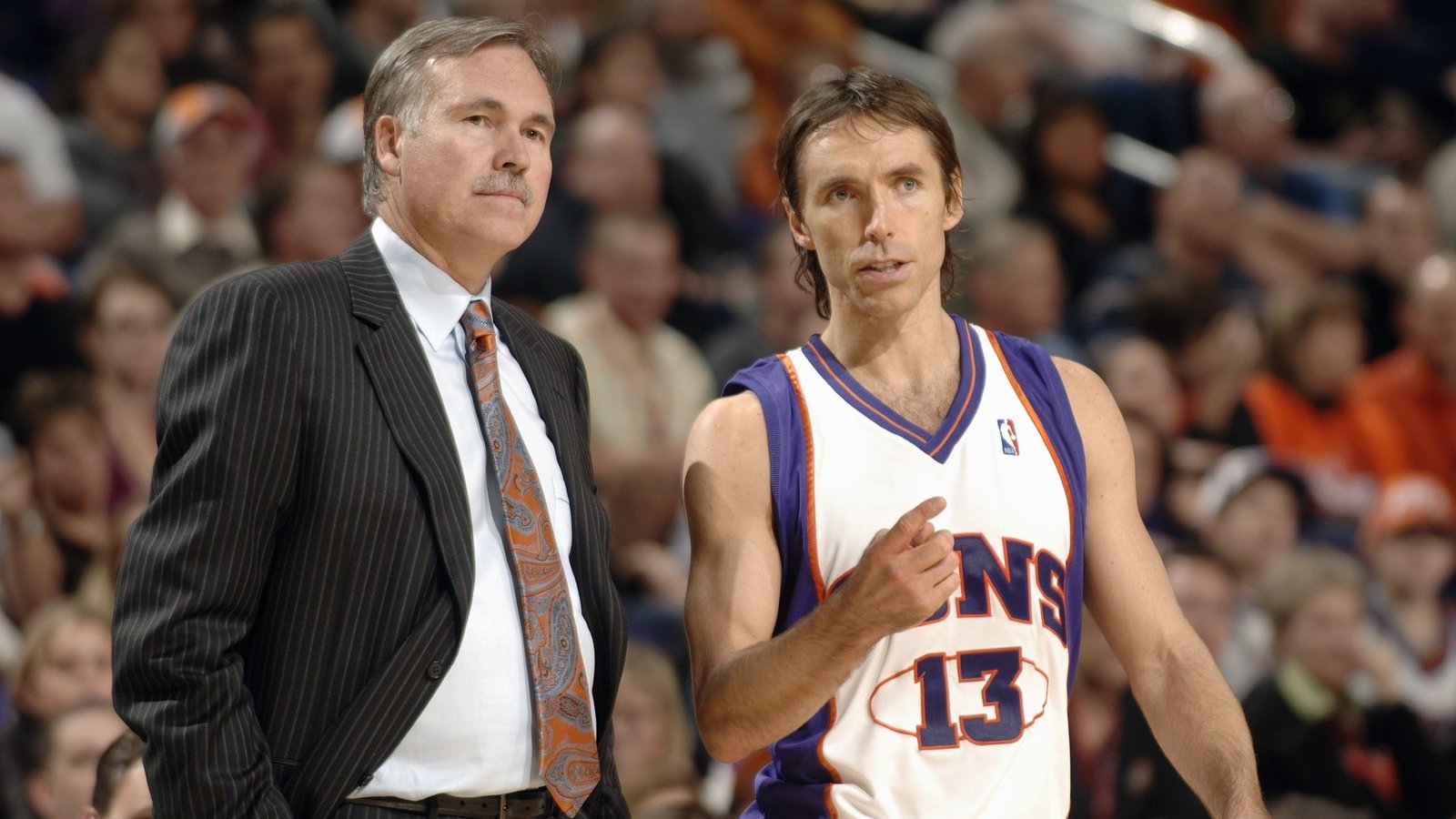
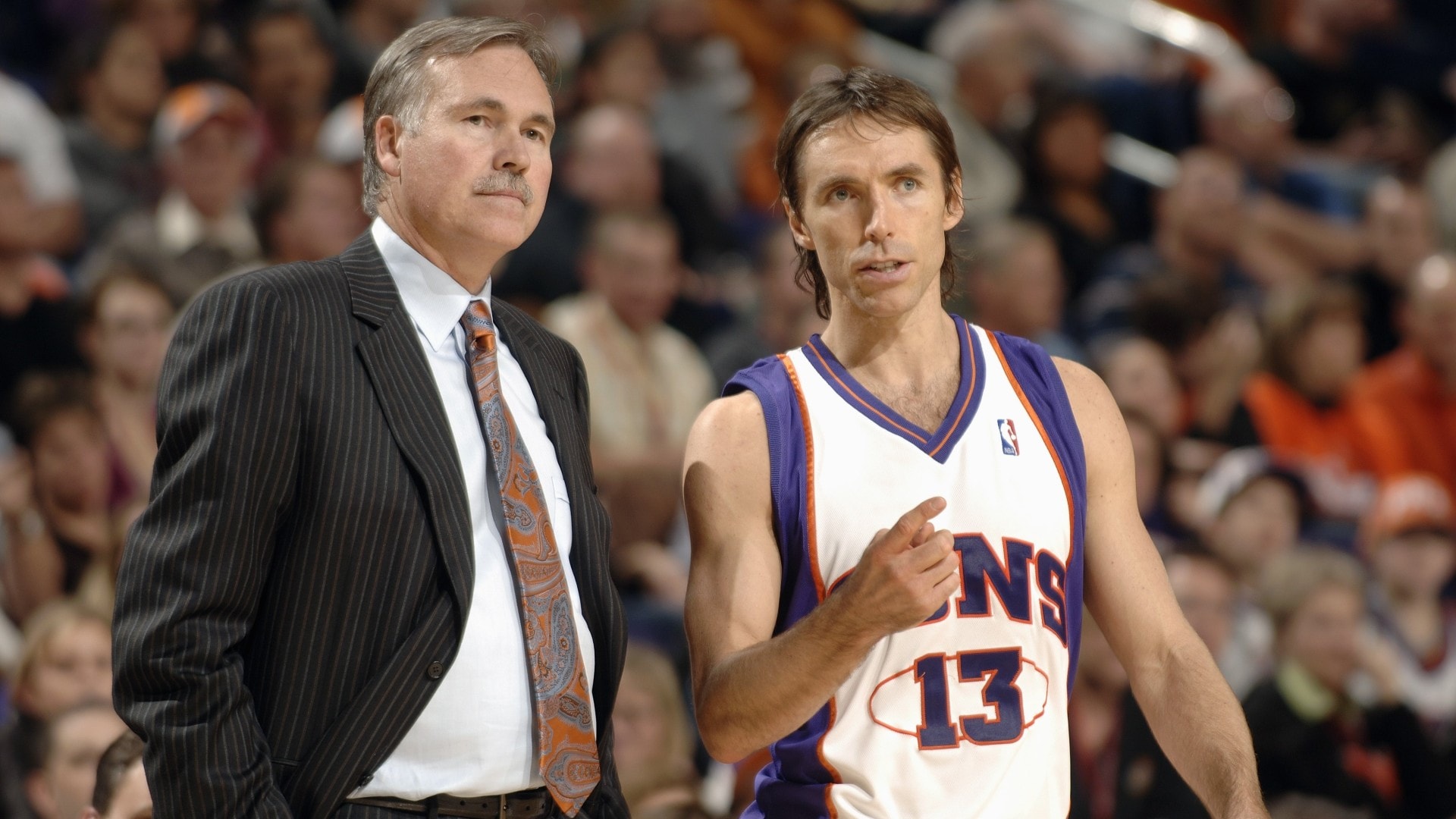
Mike D’Antoni credits much of his success to Steve Nash, who saw the game much the same way he did.
Mike D’Antoni’s coaching influences sprang from West Virginia, where he played prep basketball at Mullens High School and college basketball at Marshall. They came from Europe where D’Antoni had a stellar career as one of the best point guards in Italy’s top pro league and from Doug Moe who D’Antoni played for briefly in the NBA.
The amalgamation of those influences provided inspiration for D’Antoni who as a coach ushered in a style of basketball that altered the direction of the NBA and college hoops.
Play fast, spread the court, shoot 3-pointers, attack the rim and see what happens when you play your five best players regardless of size.
When D’Antoni got his chance to see what that kind of offense could do as head coach of the Phoenix Suns in 2003, he flourished and began cementing his reputation as an offensive innovator.
“Most coaches are the products of all the past experiences, and I had a lot,” he said. “Even growing up, the teams I always played on in high school and in college at Marshall, we were always undersized and fast and were really successful. And then as you get into the pros, you just follow your coaches.”
For his accomplishments as a head coach in Italy and with the Suns, New York Knicks, Los Angeles Lakers and Houston Rockets, D’Antoni will be enshrined in the Naismith Basketball Hall of Fame Saturday. He enters the Hall as a contributor.
“It’s just an unbelievably proud moment, and I’m deeply honored,” D’Antoni said. “It’s something that I didn’t expect.”
Expected or not, his impact on basketball is undeniable. In 16 seasons as an NBA head coach, D’Antoni was 672-527 in the regular season and 54-56 in the playoffs. He earned Coach of the Year honors in 2004-05 and 2016-17, took three teams to the Western Conference Finals (Phoenix in 2005 and 2006 and Houston in 2018) and coached two players in their MVP seasons (Steve Nash twice and James Harden once).
His first full season with the Suns in 2004-05 featured Steve Nash, Amar’e Stoudemire, Shawn Marion, Joe Johnson and Quentin Richardson. They started 31-4 and finished 62-20. The Suns led the league in scoring (110.4 points per game), offensive efficiency (114.5 points per 100 possessions) and pace (95.9). They were No. 1 in 3s made (9.7 per game), 3s attempted (24.7 per game) and 3-point shooting percentage (.393).
They confounded the rest of the league – it was in some ways an antidote to Shaquille O’Neal, Tim Duncan and other paint-dominant big men – and D’Antoni’s Suns set in motion an offensive style that permeates today. Last season, the Golden State Warriors – their success and four championships are not lost on D’Antoni – shot 44.1 3s per game and even the No. 30 team in 3s attempted per game, the Sacramento Kings, shot 30.2 per game.
They weren’t the first team to play fast, shoot a lot of 3s or play small, especially at center and power forward, but D’Antoni combined those methods in a way that pushed offensive innovation. Those Suns were immortalized in Jack McCallum’s book :07 Seconds or Less: My Season on the Bench with the Runnin’ and Gunnin’ Phoenix Suns.
“A coach is only as good as his players are,” D’Antoni said. “And I got really lucky.”
D’Antoni named a handful of those players, but none were as instrumental in executing his vision as Nash, who saw the game similarly and had the skillset as a ballhandler, passer and shooter to make it work. Nash had a gift for quickly exploiting defensive weaknesses.
“I got lucky with Steve Nash,” D’Antoni said. “You always hear through the years, you have a good point guard, you’re going to be successful as a team. I was just trying to maximize the point guard, trying to maximize spacing, use the three. And I just went with it. You tweak it every year, you do a little bit different. You have different personnel. But the basics were there. It started in Italy and I just kind of ran with it.”
As a player, especially in Italy, D’Antoni acknowledged he wasn’t a great finisher in the paint, so he liked shooting 3s. As a coach in Italy, he was enamored with the skillset of Europeans no matter what position they played. Ballhandling, passing and shooting from all areas of the court were necessary for all players, and D’Antoni also became frustrated with a paint area clogged with defenders.
“The one thing that I was able to jump on real quick was the big guys. I thought they were much more skilled,” D’Antoni said. “They could shoot the 3, they could run, they could handle the ball. We could do a lot of different things, and I could open up the game a lot more because of their skill. So that was probably the influence that Europe gave me was that you can play five out because you’re center and four guy and everybody, you have five skilled players on the court.”
With success in Italy – two Italian league championships, two Italian Supercup titles and a EuroLeague Final Four appearance – D’Antoni craved an opportunity to see if his offensive ideas would work in the NBA. He also admitted that came with consternation.
“I was insecure as a coach coming back to the NBA whether it would work or not,” he said.
Besides players, D’Antoni benefited from rules changes that favored offense – defensive three seconds, restrictions on perimeter hand-checking – and an ownership and front-office group led by Jerry Colangelo and Bryan Colangelo that were open to D’Antoni’s ideas.
“I had the right personnel, and it all fell into place,” D’Antoni said. “And whether I could see that or not, I always wanted to play that way. It was the best way to go for us. I had the right personnel and the right owners and the right general manager and we all just went with it.”
* * *
Leave a Reply