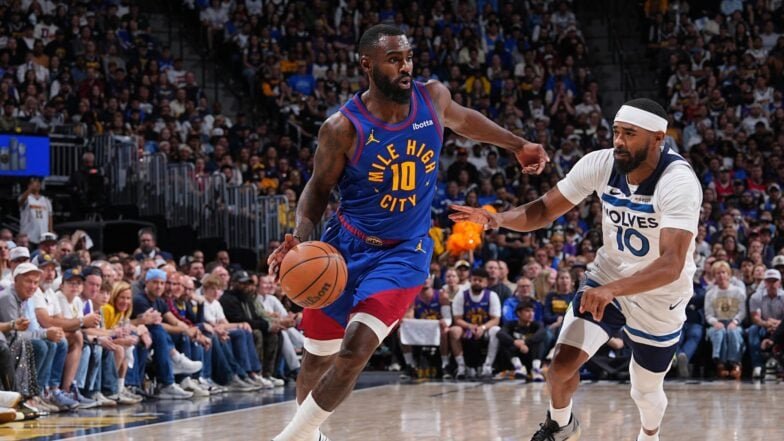
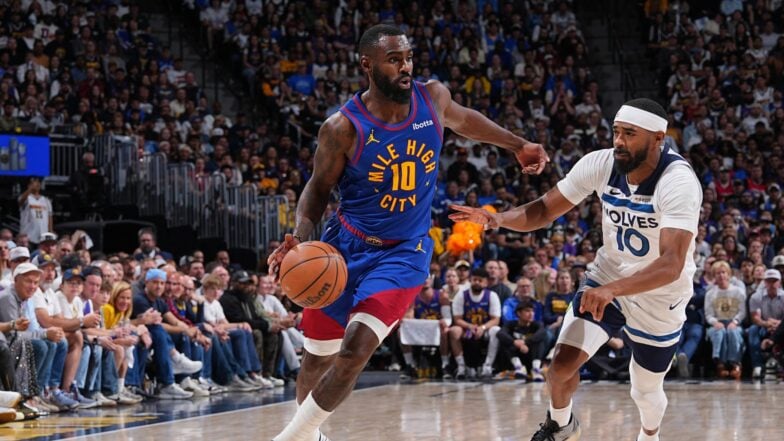
“I’ve embraced that role,” Hardaway says of coming off the bench.
Editor’s Note: Read more NBA coverage from The Athletic here. The views on this page do not necessarily reflect the views of the NBA or its teams.
***
DENVER — The two words that may have changed the Denver Nuggets’ season were spoken in the summer, during a phone call between head coach David Adelman and free agent Tim Hardaway Jr.
In search of a catch-and-shoot weapon, some scoring off the bench and a heady veteran as a target for plays after timeouts, Adelman told Hardaway what every shooter dreams of hearing:
Green light.
“I just said I was gonna let him be exactly what he is,” Adelman said. “The green light is the green light: If he feels like there’s an inch of him being open, he should shoot the ball.”
Throughout his 13-year NBA career, Hardaway has to come to realize words matter. Early in his career, then-Atlanta coach Mike Budenholzer bluntly stated he would not play him. In New York, jeers from the Madison Square Garden crowd echoed in his head. And in Dallas, the silence from coach Jason Kidd amid a late-season benching cut so deep that he cried.
To Hardaway, Adelman’s words felt like more than just a sales pitch from the Nuggets. He felt like he was seen. Appreciated. Valued. His recruitment was over.
“Him reaching out and saying that, that’s all I really needed,” said Hardaway, who played for the Detroit Pistons last season.
Nine months later, Hardaway is a finalist for the NBA’s Sixth Man of the Year award, which will be announced Wednesday, and is being regarded as a lifesaver for a Nuggets season that could have easily gone off the rails because of injuries. On Monday, Hardaway was a first-half spark plug against Minnesota in the teams’ first-round series. Adelman said everything he imagined Denver was getting with Hardaway has been exceeded.
“Beyond what I expected,” Adelman said. “He is one of the main, main reasons why we survived this season. The guy won us games. Flat out. Just really, really impactful.”
Added Jon Wallace, the Nuggets’ executive vice president of player personnel: “He’s had immense value for us.”
Adelman and Wallace call Hardaway the “perfect fit” — a description Hardaway revels in because it reminds him of the imperfect path he has taken to Denver. Now here he is at age 34, not only surviving but flourishing on a team with championship aspirations. He sees himself as a testament to humility, perseverance and vulnerability.
“It’s learning from my mistakes,” Hardaway said. “Embracing those mistakes.”
Before his career-best 40.7 percent shooting from 3-point range this season, and before he led the NBA with 205 3-pointers off the bench, and before he tied an NBA record with five games of at least seven 3-pointers off the bench, there was Atlanta.
“Rock bottom?” Hardaway repeated before a long pause. “It was Atlanta. One-thousand percent.”
It was his third NBA season, in the summer of 2015 after he had been traded to the Hawks from New York, which moved on after taking him with the 24th pick in 2013. After averaging a little more than 23 minutes a game in New York, Hardaway thought he was headed for a bigger role with the Hawks.
Instead, he found himself sitting in Budenholzer’s office, getting a lecture.
“Bud was like, ‘You’re not gonna play the first 25 games. I don’t care if people are injured or not. Like, you won’t see the floor. We’re trying to make you into the player we want you to become,’” Hardaway remembered.
He sensed this was the beginning of the end. He wondered if he was destined for the leagues in Europe. He said he called his agent daily, as well as his Hall of Famer father, point guard Tim Hardaway Sr., fretting about his future.
“It was my lowest point; I didn’t know if I was going to be sticking around,” Hardaway said.
Budenholzer’s office sermon played on repeat in his mind. Today, Hardaway remembers the entire conversation as if it was yesterday. Budenholzer wanted him to be in better shape so he could not only shoot, but also defend. He wanted him to be on time. He wanted him to work on his game outside of team practices and shootarounds. He wanted him to start eating better and taking care of his body.
“He really gave me the blueprint of how to stay in the league,” Hardaway said.
Budenholzer’s 25-game threat didn’t quite materialize — Hardaway played in the season’s 16th game — but of the first 35 games, he appeared in only four. In the meantime, he had tours in the then-NBA Development League for the Canton Charge and Austin Spurs.
When he returned to Atlanta, Hardaway had changed. He was arriving at the arena four hours before games and getting in extra work. If he wasn’t on the court, he was on a treadmill or stair climber.
In the vacant arenas, and amid the rhythmic pounding on the treadmill, he gained a deeper appreciation of the men from his childhood, who worked out and played with his father.
The younger Hardaway began to understand the league wasn’t just about skill. It was about dedication and work ethic.
“It made me appreciate the grind and appreciate the people who came before me,” he said.
Rock bottom morphed into a trampoline. He says his second season in Atlanta is his favorite of his 13 seasons. What used to be a grind — the workouts, the discipline, the punctuality — became his comfort. His scoring vaulted from 6.4 to 14.5 points, and his games played went from 51 to 79, including 30 starts.
He had become a pro.
Today, Hardaway says any time he sees Budenholzer, he makes sure he approaches him.
“Every single time I see him, I thank him,” Hardaway said. “Yes, what he said was harsh. But it’s what made me the player I am today. He wanted me to be the best basketball player I could be. And he wanted me to work and see how hard it is to stay in this league.”
Ten years later, at the Nuggets’ training camp in San Diego, Hardaway would pay it forward. In September, on the first day of Denver’s training camp, Wallace and Ben Tenzer, the team’s executive vice president of basketball operations, took an Uber to the team’s first practice. When they opened the gym, they froze.
Practice wasn’t scheduled to start for another 45 minutes. Coaches hadn’t even arrived at the gym. But there was Hardaway, leading shooting drills with Peyton Watson and Bruce Brown.
“That was the moment where we said, ‘All right, this dude is a cornerstone,’” Wallace said.
Added Tenzer: “It was really inspiring and exciting to see that.”
It was a tone-setting moment, borne in part from Hardaway’s Atlanta days, in part from idolizing videos of Ray Allen, who touted the need to get to the arena early, and in part from his youth, when he would attend offseason workouts of his legendary father. Every summer, he would wake up at 6 a.m. and join his dad’s workouts with trainer Tim Grover in Chicago, which included Chicago royalty like Michael Jordan, Michael Finley and Juwan Howard.
“My dad always said you have to work on your game when no one is watching,” Hardaway said.
Adelman said subtle touches, like Hardaway showing up early on the first day, how he speaks up in huddles and his overall perspective, has been a major element to the team’s chemistry.
“It’s so nice to get people who have had success in their career … but who have also failed,” Adelman said. “He’s been a starter, been a sixth man, been the ninth man. Guys like that who have survived all those years and still have an impact yearly, it shows why he’s been around so long. It’s why he has fit so well. It’s just been a perfect fit.”
In a locker room with matted, business-like personalities like Nikola Jokić, Jamal Murray and Aaron Gordon, Hardaway has been a dash of color. He is loud, often smiling and unafraid to speak his mind.
“He’s a likable, compatible person, but he’s not afraid to say what he’s thinking … to anybody,” Adelman said. “Conversations I’ve had with him, where he’s frustrated, it’s refreshing to have somebody be emotionally accepting of who they are. A lot of these guys try to hide their emotions nowadays. It’s 2026. Everybody’s on their phone. Everybody’s inside of themselves. But Tim lives life and plays basketball expressively, and I love that about him.”
Added starter Christian Braun: “He’s a good voice, a good personality. He’s been somebody we’ve kind of rallied around. He’s been one of the most important additions, I think, around the league this year.”
Hardaway said the end of his 5 1/2-year tenure in Dallas helped shape his outlook on what it means to be a teammate. In 2024, as the Mavericks began their march to the NBA Finals, Hardaway slipped out of Kidd’s rotation after 11-of-44 shooting from 3 in April.
The demotion staggered him. For weeks, he said he “tried to be a man about it” by internalizing his feelings. But as the playoffs neared, his father visited him, and while the two were at the son’s home, the younger Hardaway could no longer contain his emotions.
“I just started asking, like … Why? Why? Why?” he said.
He broke down and cried. And for the first time in his life, he said he felt the presence not of Hall of Famer Tim Hardaway Sr., but rather the connection of Tim Hardaway Sr., the dad.
“What set me over the top and made me emotional was my dad just being there for me,” Hardaway said. “I mean, you have the father, the pro basketball player, but at that moment, he was dad. He was what I wanted when I was a kid.”
He told his dad he needed help. He didn’t know how to handle his emotions. His dad told him he couldn’t let his disappointment and anger bring down the team.
“He put his arm around me. We gave each other a hug, and we talked for hours and hours and hours,” Hardaway said of his father. “He did what I feel a dad should do for his son. It was tremendous. He helped me understand how I can, like, give my energy to others. And it helped me understand that it doesn’t hurt to ask for help.”
In the playoffs, Kidd didn’t play Hardaway in the final four games of the first-round series against the LA Clippers. In the Western Conference finals, he played 15 minutes combined in the first two games, then was benched for the final three games. In the NBA Finals against Boston, he was an afterthought.
Even though the elder Hardaway would later criticize Kidd for having no communication with his son about the benching, the younger Hardaway said it became a learning experience. He learned that the team is bigger than a person.
“I always say this: The decision was made,” Hardaway said. “I could either be a person who sulks and not work, or I could be the person who works and be a great teammate to the guys who are in front of me. If they needed help or have any questions, I was there to help them out.
“And listen, we went to the finals. So, what can I say, you know?”
Before the Nuggets’ April 4 game against San Antonio at Ball Arena, the Denver public relations staff circulated a promotional flier touting Hardaway’s accomplishments this season, a campaign to trumpet his case for Sixth Man of the Year. The next day, Hardaway was shown the sheet, and he grinned as he studied the bullet points:
- Most 3-pointers off the bench in the NBA this season
- Career-high and best 3-point field goal percentage among reserves
- Tied for the most games in NBA history with seven or more 3s off the bench
- A total of 17 games with 20 or more points
- Career turnover rate the best in NBA history.
“Crazy,” he said going down the list, his smile still wide, eyes twinkling. “Oh … wow … in history …”
What is he most proud of on the list?
“What sticks out is all of these have to do with coming off the bench,” Hardaway said. “It means I’ve embraced that role. I’ve been a star in this league for numerous years, but to go to the bench … first, you gotta embrace it and accept the fact that this is your role; then, you have to be effective. I feel like I’ve done that, and it shows … right here.”
He flicked the paper with his fingers for emphasis. In his 13 years, no team had promoted him like this. He is a finalist for the award along with Miami’s Jaime Jaquez Jr. and San Antonio’s Keldon Johnson, and there’s something about being in the mix, at this time of his career while working on a veteran’s minimum contract ($3.6 million), that hits differently.
“Whoever wins that is going to be very deserving,” Hardaway said of the award. “The field is very good this year. We all know what the bigger picture is: Everybody wants to win a championship. But to even be in the conversation for the Sixth Man award, I mean, it’s amazing. I’m happy about it.”
The next night, he went out and hit three 3-pointers against the Memphis Grizzlies to move past Michael Porter Jr. and into second on Denver’s all-time list for 3-pointers in a season with 224 (Murray holds the record with 245, set this season). Murray after the game proclaimed Hardaway the winner of the Sixth Man award.
Meanwhile, Adelman says Hardaway’s confidence is as high as any player he has coached, no doubt influenced by the summer conversation on the phone.
“I’ve said this all season: His green light is as bright as it can be,” Adelman said. “That’s his role on this team … and it’s what he has been doing all year. Like clockwork.”
***
Jason Quick is a senior writer for The Athletic. Based in Portland, he writes about personalties and trends of the NBA, with a focus on human connections. He has been named Oregon sportswriter of the year four times and has won awards from APSE, SPJ, and Pro Basketball Writers Association.
Leave a Reply