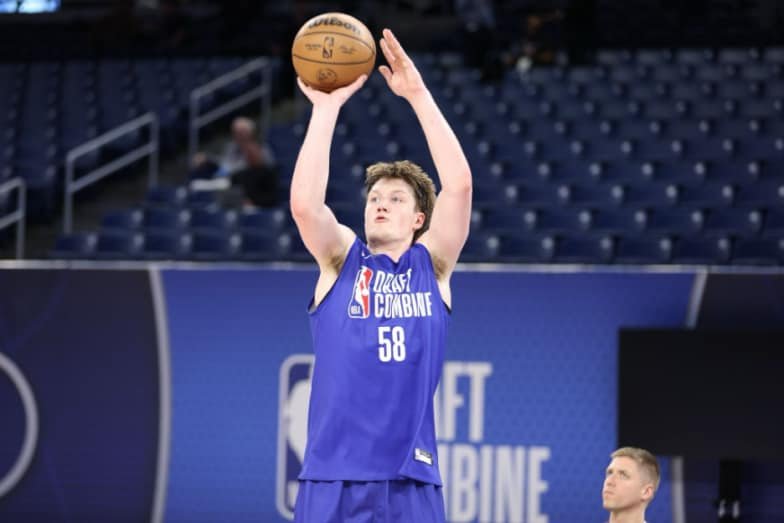
Top prospect Cooper Flagg goes through drills at the Combine and talks about taking the next step in his career.
The AWS NBA Draft Combine — held from May 10-17 — is a week-long gathering in Chicago where top Draft prospects participate in skills drills, scrimmages, get official anthropometric measurements and have the opportunity to meet with NBA team officials.
Last year, 75 prospects participated in the NBA Draft Combine, including every player that would go on to become a lottery pick in the 2025 NBA Draft – a group led by Cooper Flagg, Dylan Harper, VJ Edgecombe, Kon Knueppel and Ace Bailey as the top five picks.
With 71 players filing as early-entry candidates for the 2026 NBA Draft, the number of prospects at this year’s Draft Combine may be even higher. Below is an overview of the stations and activities that Draft prospects will participate in while attending the AWS NBA Draft Combine.
Anthropometric measurements
Hand length and width, height without shoes, percentage of body fat, standing reach, weight and wingspan are measured.
Strength and agility tests
After dynamic warm-up, no-step vertical jump, maximum vertical jump, pro lane drill, three-quarter court sprint, lane shuttle drill (players will complete drills in small groups; within each group, expected order will be lowest jersey number to highest jersey number).
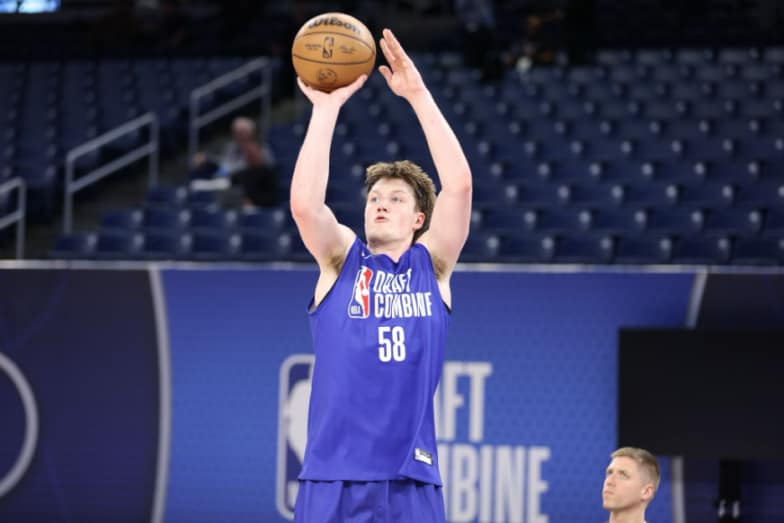
Kon Knueppel participates in shooting drills at 2025 NBA Draft Combine.
Shooting drills (required of each participant)
Players are required to complete each of the following drills:
- Off-the-dribble shooting
- Spot-up shooting
- Star drill (3-point OR Mid-range)
- Side-mid-side drill (3-point OR Mid-range)
- Free throw shooting
See below for a detailed look at the shooting drills.
Live action offense vs. defense drills (optional)
After warmups, there will be three categories of optional live action offense vs. defense drills:
- Simulated actions (Two-on-two/Three-on-three)
- Transition drill (Four-on-four)
- Four-on-four half court
See below for a detailed look at the offense vs. defense drills.
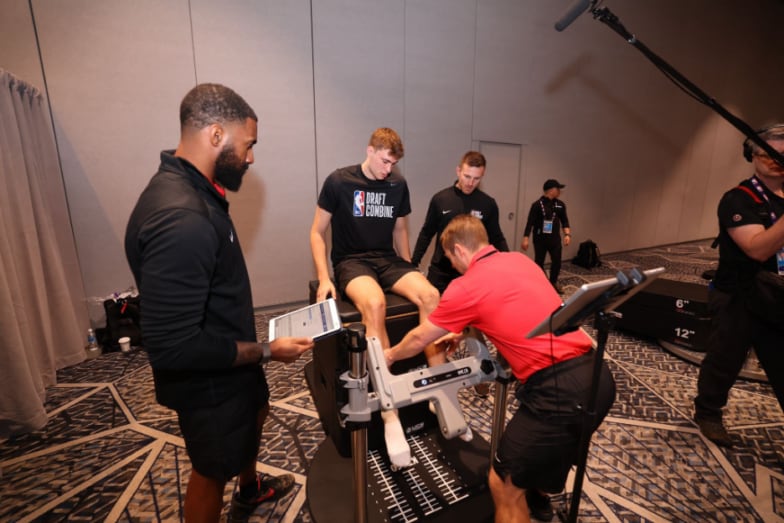
Cooper Flagg goes through measuring at 2025 NBA Draft Combine.
Biomechanical and functional movement testing
Biomechanics assessment via NBA providers; isometric strength assessment
Medical intake & Medical history information
In-person medical screening/exam and history review with orthopedic physician and sports medicine physician, blood draw for medical lab tests, and DEXA. These activities will follow a virtual intake, prior to the Combine, with an orthopedic physician and collection of medical history information (including prior medical records)
Five-on-five scrimmages (Optional)
Pro days (If necessary)
Facilitated by the NBA with content organized by players and player representatives
SHOOTING & LIVE ACTION OFFENSE VS. DEFENSE DRILLS
SHOOTING DRILLS (REQUIRED)
Players are required to complete each of the shooting drills below as directed by the NBA. Four baskets will be utilized for shooting drills.
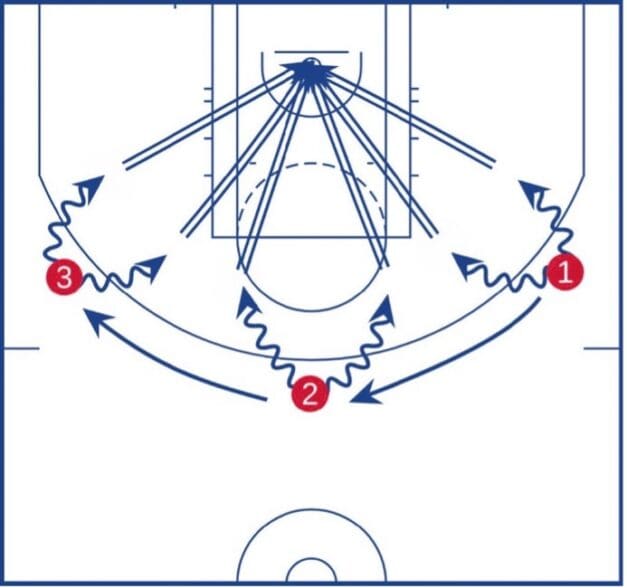
Off-the-dribble shooting
Shoot from three locations (right wing through top-left wing). At each location, the player will take 10 shots, alternating his dribble in each direction (e.g., one shot dribbling right, one shot dribbling left, one shot dribbling right, and so on).
- Right Wing: Start on the right wing outside of the NBA 3-point line (shoot 15’-18’ jump shots).
- One dribble right – pull-up jump shot and return to the initial spot
- One dribble left – pull-up jump shot and return to the initial spot
- Top of the Key: Start at the top of the NBA 3-point line (shoot 15’-18’ jump shots)
- One dribble right – pull-up jump shot and return to the initial spot
- One dribble left – pull-up jump shot and return to the initial spot
- Left Wing: Start on the left wing outside of the NBA 3-point line (shoot 15’-18’ jumpshots)
- One dribble right – pull-up jump shot and return to the initial spot
- One dribble left – pull-up jump shot and return to the initial spot
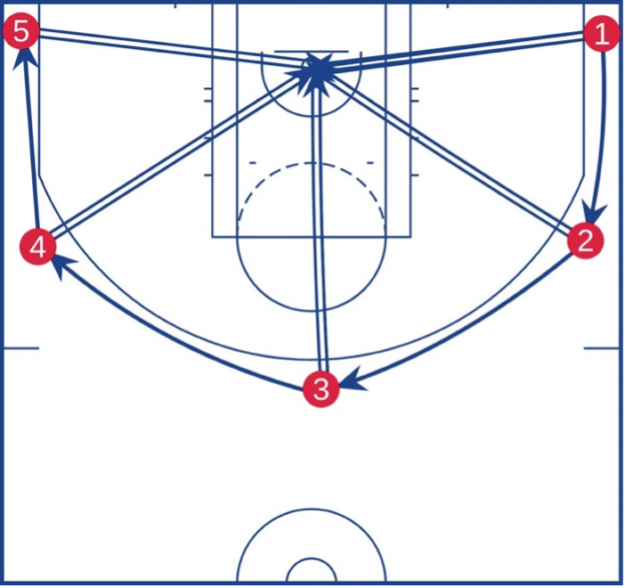
Spot-up shooting
Start in the right corner. Shoot five shots at five spots around the NBA 3-point line (right corner, break, top, break, left corner) for a total of 25 shots.
Star Drill (3-point OR mid-range)
Players are required to complete the star drill and, based on their individual shooting preference, will have the option of completing this drill from 3-point or mid-range. Upon arrival in Chicago and check-in for the Draft Combine, each player will have the option to notify the NBA that he intends to complete the mid-range version of this drill (instead of the default 3-point version). A player will also have the opportunity to choose the mid-range version by notifying the NBA before beginning the shooting drills.
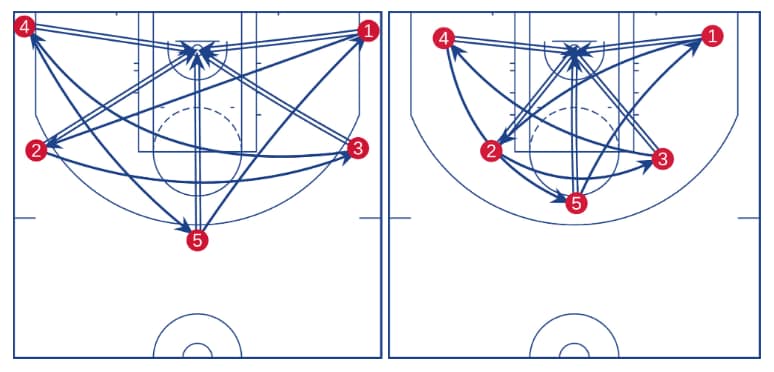
- 3-Point: Start in the right corner outside the NBA 3-point line. Take one shot in the right corner, move to the left wing, right wing, left corner, and top of the NBA 3-point line, shooting off the catch with passes from the rebounder in each location. Repeat this pattern five times for 25 total shots.
- Mid-Range: As noted above, prior to beginning the shooting drills, a player can notify the NBA that, based on his individual shooting preference, he will complete the mid-range version of this drill. The mid-range star drill option historically has been completed by players who do not consistently shoot 3-pointers. Start in the right corner inside the NBA 3-point line (mid-range). Take one shot in the right corner, move to the left wing, right wing, left corner, and top of the key, shooting off the catch with passes from the rebounder in each location. Repeat this pattern five times for 25 total shots.
Side-mid-side drill (3-point OR mid-range)
Players are required to complete the side-mid-side drill and, based on their individual shooting preference, will have the option of completing this drill from the mid-range. Upon arrival in Chicago and check-in for the Draft Combine, each player will have the option to notify the NBA that he intends to complete the mid-range version of this drill (instead of the default 3-point version). A player will also have the opportunity to choose the mid-range version by notifying the NBA before beginning the shooting drills.
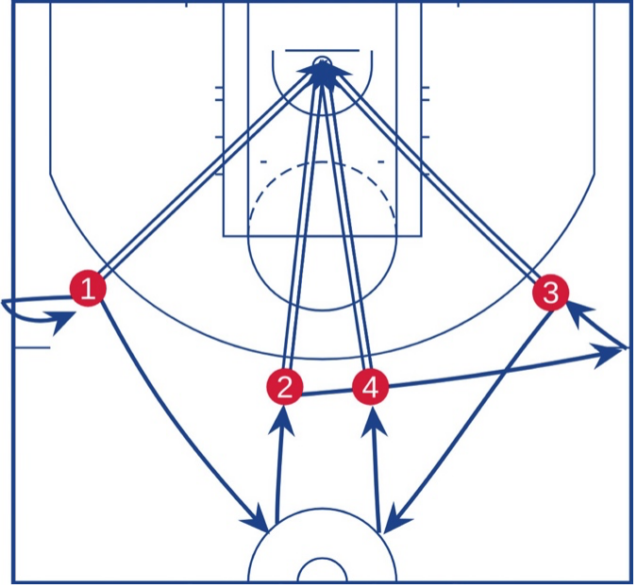
- 3-point: Repeat a cycle of four NBA 3-point jump shots on the move at game speed for two minutes.
- Start at the left wing:
- Sprint to the left sideline and then back to the left wing for a catch-and-shoot shot
- Sprint to center half court, then back to the top of the NBA 3-point line for a catch-and-shoot shot
- Sprint to the right sideline, then back to the right wing for a catch-and-shoot shot
- Sprint to center half court, then back to the top of the key for a catch-and-shoot shot
- Start at the left wing:
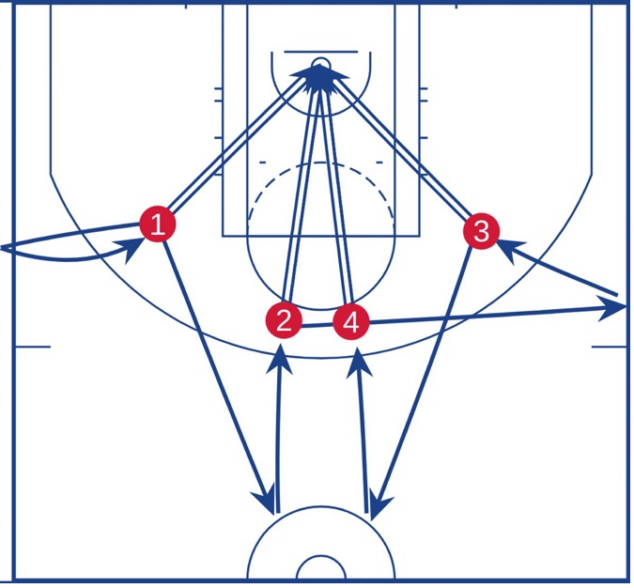
- Mid-range: As noted above, before beginning the shooting drills, a player can notify the NBA that, based on his individual shooting preference, he will complete the mid-range version of this drill. The mid-range side-mid-side drill option historically has been completed by players who do not consistently shoot 3-pointers. The player will repeat a cycle of four jump shots from the mid-range at game speed for two minutes
- Start at the left wing:
- Sprint to the left sideline and then back to the left wing for a catch-and-shoot shot
- Sprint to center half court, then back to the top of the key for a catch-and-shoot shot
- Sprint to the right sideline, then back to the right wing for a catch-and-shoot shot
- Sprint to center half court, then back to the top of the key for a catch-and-shoot shot
- Start at the left wing:
Free Throw Shooting
Shoot 10 free throws.
LIVE ACTION OFFENSE VS. DEFENSE DRILLS (OPTIONAL)
Players will have the option to participate in three categories of live action offense vs. defense drills that feature specific basketball situations that a player may encounter in an NBA game (Simulated Actions, Transition Drill, and Four-on-Four Half Court). For players participating in such drills, prior to doing so, there will be warmups (described below). The coaches operating the live action offense vs. defense drills and warmups may elect to skip a particular action or set based on timing or other considerations.
WARMUPS
Ball handling and finishing (straight line, in-and-out, crossover, euro, between legs — reverse, long layup, and floater).
SIMULATED ACTIONS (TWO-ON-TWO / THREE-ON-THREE)
TWO-ON-TWO
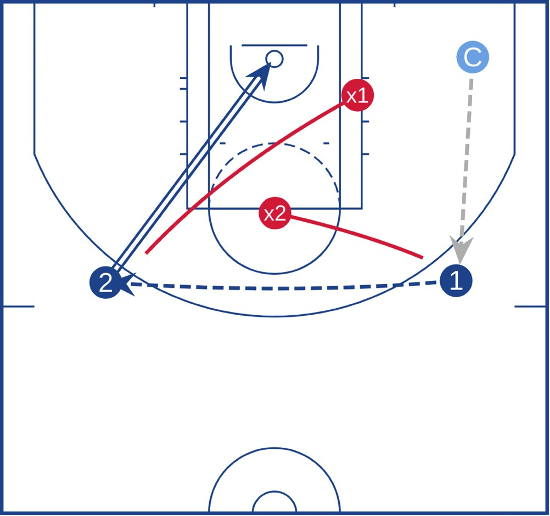
- Coach has the basketball near the baseline on either side of the court
- One offensive player is positioned on each of the left and right wings of the NBA 3-point line. One defensive player is positioned at the block and a second defensive player is positioned at the free-throw line
- Coach passes the ball to Player 1 on the wing, and Player 1 swings the ball to Player 2 positioned on the opposite wing
- Before beginning the drill, the coach will notify Player 2 that he can either shoot a 3-pointer or do a dribble hand-off (“DHO”) with Player 1. Based on Player 2’s choice, the coach will inform all 4 players whether the drill will involve a DHO
- If there is a DHO, Player 1 will shoot a 3-point shot following the hand-off, and Player 2 will roll to the basket and receive a pass from the coach for a floater in the paint (no dunking)
- Defender 1 will close out on Player 2 to contest the 3-point shot or floater in the paint (as applicable). Defender 2 will close out on Player 1 to contest the 3-point shot (if applicable). Before beginning the drill, the coach will provide Defenders 1 and 2 with any additional or alternate instructions (for example, whether to switch or stay with their initial offensive assignment)
THREE-ON-THREE WITH ADVANTAGE
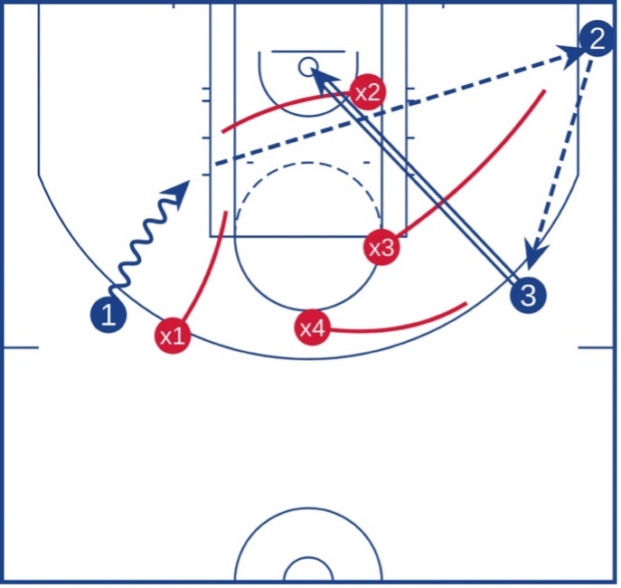
- Three players are positioned on the NBA 3-point line (left wing / right wing / corner)
-
- Option 1: Player 1 has the ball on the left wing, drives toward the basket, and passes to Player 2 in the corner. Player 2 swings the ball to Player 3 on the wing for a 3-point jump shot or a dribble hand-off (“DHO”) with Player 2
- Option 2: Player 1 has the ball on the left wing, drives toward the elbow, and passes to Player 2 on the wing. Player 2 swings the ball to Player 3 in the corner for a 3-point jump shot or a dribble hand-off (“DHO”) with Player 2
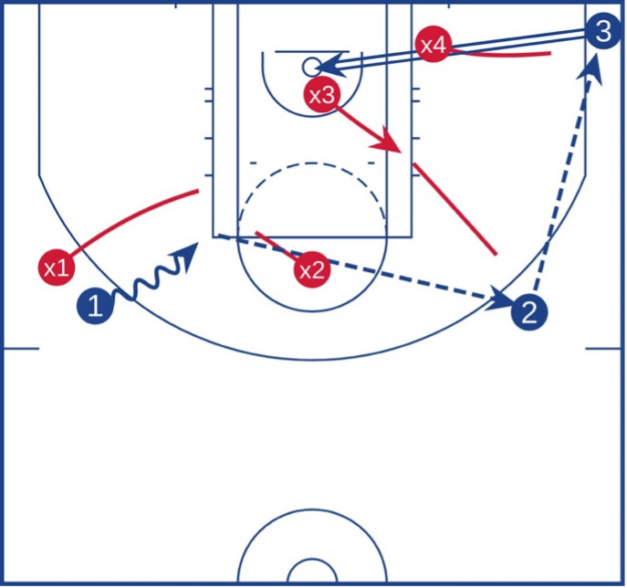
- Before beginning the drill, coaches will notify the players that they can execute either Option 1 or 2 and that Player 3 can either shoot a 3-point shot or do a DHO with Player 2. Player 3 will inform the coaches and other players of his choice
- If there is a DHO, Player 2 will shoot a 3-point shot following the hand- off; Player 3 will roll to the basket and receive a pass from a coach for a floater in the paint (no dunking)
- Four coaches will be positioned throughout the drill for soft contests on 3-point shots and floaters in the paint
TRANSITION DRILL (FOUR-ON-FOUR)
- Four players on offense are positioned on the baseline. Four players on defense are positioned on the free throw line (extended, directly opposite the players on offense)
- A coach passes the basketball to an offensive player positioned on the baseline
- When the offensive player receives the ball from the coach, the defensive player who is positioned directly in front of that offensive player sprints to touch the baseline and then gets back on transition defense
- When the offensive player receives the ball, the offense can immediately begin to advance the ball down the court in an attempt to score. The other three defensive players must get back on defense and attempt to slow down the offense’s transition attempt until the fourth player gets back on defense
FOUR-ON-FOUR HALF COURT
PICK AND ROLL
- High Pick and Roll / Side Pick and Roll
- Actions can be initiated by an off-ball screen
- Once live, defenders will be instructed to do the following:
- Hedge, Show and Recover, Switch, Trap
SCREENING AND OFF-BALL ACTIONS (CORNER SPLIT / HIGH SPLIT)
- Players will be positioned at the following locations:
- Elbow / Corner / With ball starting above the NBA 3-point line
- Ball handler will pass to the elbow or corner to initiate the action
- Once live, players can run the following actions:
- Delay, Dribble Hand-Off, Stationary Hand-off, Backscreens, Down Screens, Off-Ball Cuts
- This action could still include pick and roll
THUNDER CLOSE-OUT
- Offensive players will be positioned at the following locations:
- Two high wings and corner
- Defensive players will be positioned at the following locations:
- Four spots / lines along the baseline — one in each corner, and one on each free throw line lane line
- Coach can throw the ball to one of the offensive players in the corner:
- Once live, players can run any action
- In a three-on-three situation, go triangle close-out:
- Players will be positioned on both wings and top of key
Leave a Reply